Pruning saws: folding, curved and scabbard saws for palms, trees and shrubs
By FITTO Trade Desk · Last updated 29 October 2026
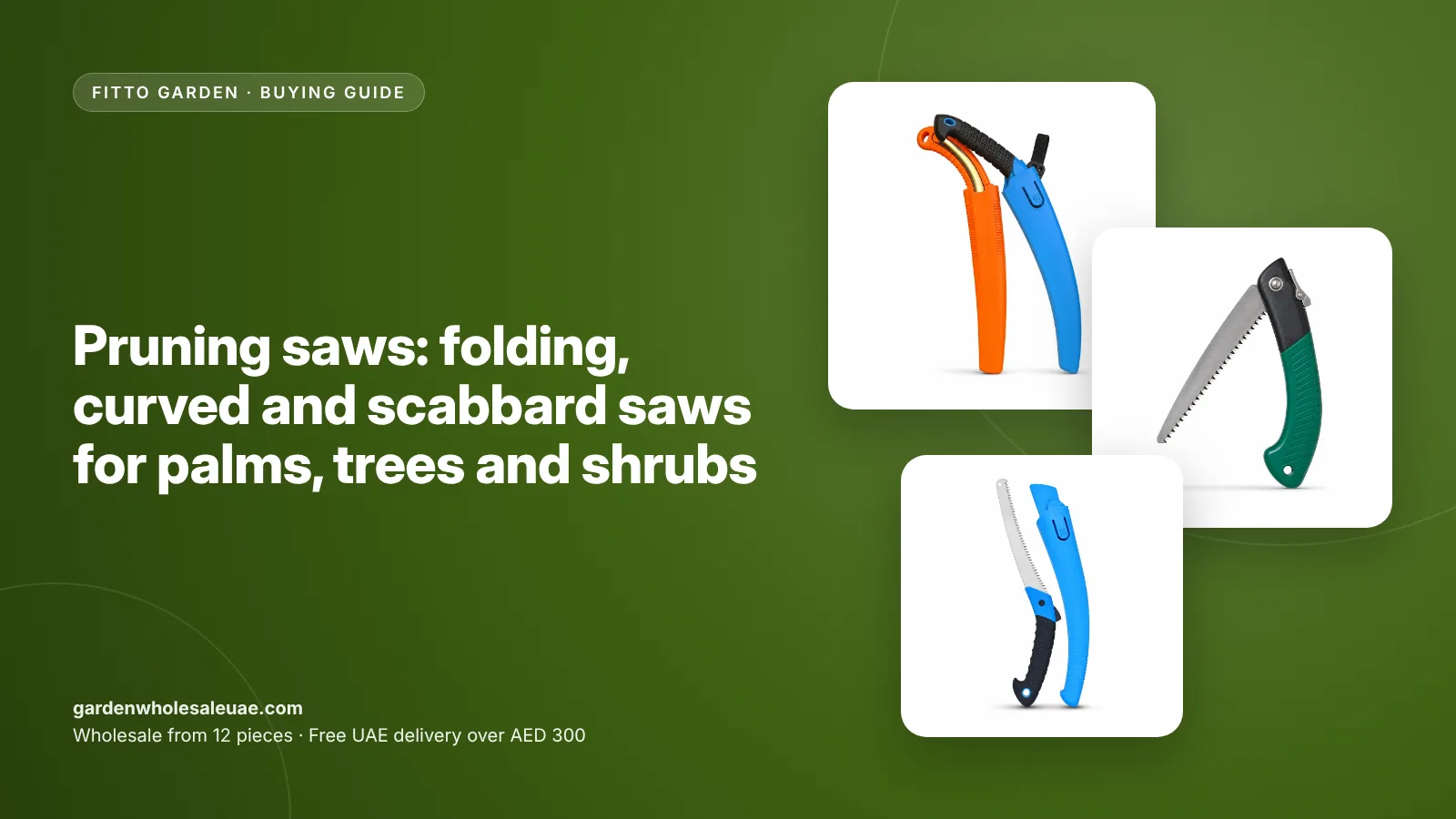
A pruning saw for UAE gardens should match the branch, not the budget. A 35 cm folding saw handles shrubs and branches up to about 5 cm. A 40 cm straight saw with scabbard suits regular villa work. A 45-55 cm curved saw clears thicker limbs and dry palm fronds faster on the pull stroke.
Key takeaways
- Match the saw to the branch: folding for up to about 5 cm, straight 40 cm for 5-10 cm, curved 45-55 cm for thicker wood and palm fronds.
- Curved blades pull themselves into the cut, which helps overhead and on fibrous palm frond bases.
- Remove only dead and yellowing palm fronds; over-cutting green fronds weakens the palm.
- Use the three-cut method on any branch heavy enough to tear bark as it falls.
An undersized saw turns a ten-minute job into an hour of hacking and leaves torn bark that heals slowly. For a pruning saw, UAE gardens add two demands: fibrous palm fronds and heat that punishes handles and crews.
This guide, for landscapers and villa owners, settles which saw to buy for each branch size and how to cut palms safely. At FITTO Garden, a wholesale gardening tools supplier in the UAE, we stock folding, straight and curved pruning saws from 30 cm to 55 cm.
What size pruning saw do you need for each branch?
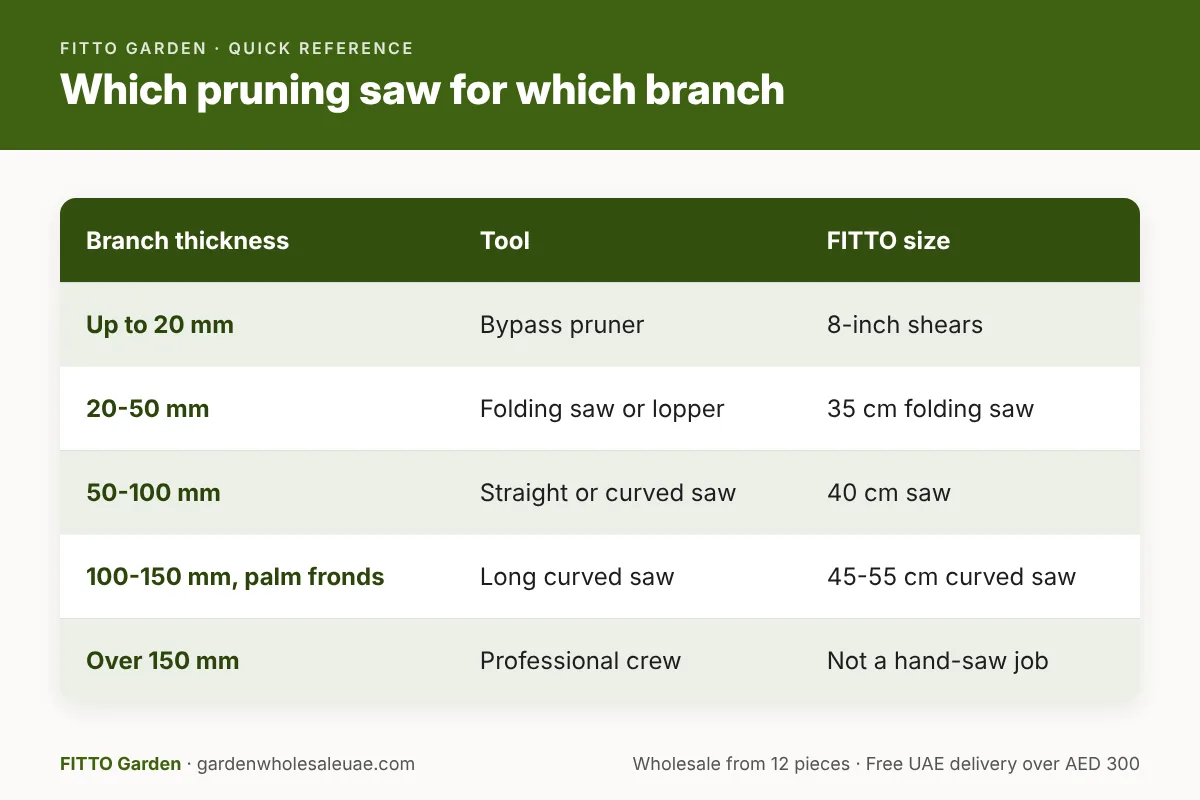
Pick the saw by branch thickness. Hand pruners stop at about 20 mm, a folding saw covers small branches, and a long curved saw takes thick limbs and palm fronds.
Sizes below are the listed sizes in FITTO product titles; the blade is shorter than the overall tool. As a rule of thumb, choose a blade at least twice as long as the branch is thick.
| Branch or frond thickness | Tool to use | FITTO sizes to look at | Why |
|---|---|---|---|
| Up to 20 mm | Bypass pruner | 8-inch bypass shears | One clean squeeze; a saw is slower here |
| 20-50 mm | Lopper or folding saw | 35 cm folding saw, 60 cm lopper | Fast cuts, fits a pocket or tool bag |
| 50-100 mm | Straight or curved hand saw | 40 cm saw with scabbard, 40 cm curved saw | Longer strokes, steady control |
| 100-150 mm and palm fronds | Long curved saw | 45 cm and 55 cm curved saws with scabbard | Curve pulls into fibrous wood |
| Over 150 mm or high crowns | Arborist or powered saw | Not a hand-saw job | Needs trained crews |
For the smaller cuts, our pruning shears buying guide covers blade types and grip sizes.
Folding, straight or curved: which pruning saw style suits the job?
A folding saw is the everyday carry, a straight saw with scabbard gives precise flush cuts, and a curved saw is fastest on thick, overhead or fibrous wood.
| Saw style | FITTO options | Best for | Trade-off |
|---|---|---|---|
| Folding | 35 cm foldable saw; shears and folding saw sets | Shrubs, hedges, bougainvillea, quick jobs | Shorter blade, slower on thick wood |
| Straight with cover | 30 cm saws, 40 cm saw with scabbard | Flush cuts near the trunk, tight spaces | Less bite on overhead cuts |
| Curved | 35 cm and 40 cm curved saws | Fruit trees, ghaf and neem branches | Needs a cover or safe hanging spot |
| Curved with scabbard | 45 cm orange, 55 cm blue | Palm fronds, thick limbs, crew belts | Bulkier to carry and store |
The curve keeps the teeth pressed into the wood as you pull, so you push less and control more. Villa owners with a few shrubs rarely need more than a folding saw. Crews working date palms (nakheel) should carry one long curved saw and one folding saw per person.
Which tooth style and handle should you choose?
Choose coarse teeth for live, sappy wood and finer teeth for dry hardwood, on a grip that stays secure in sweaty hands.
Pull-stroke saws cut as you draw the blade towards you, which keeps thin blades from bending. Coarse teeth suit sappy branches and frond bases; fine teeth leave a cleaner face on dead hardwood.
- Rubber grips hold better when hands sweat on summer mornings.
- Wooden handles stay cooler in the sun but should be kept out of standing water.
- Bright plastic handles in orange, yellow or blue are easy to find in leaf piles.
How do you cut palm fronds safely with a pruning saw?
Remove only dead and yellowing fronds, cut a few centimetres from the trunk with a long curved saw, and leave tall palms to trained climbers.
Date palm frond bases are fibrous and often spiny. A 45 cm or 55 cm curved saw reaches past the spines and pulls through the fibres.
- Wear thick gloves, long sleeves and eye protection against spines and fibre dust.
- Remove dead and yellowing fronds first; leave healthy green fronds in place.
- Cut a few centimetres out from the trunk, not flush, so you do not wound the trunk.
- Keep your free hand well away from the cut line, or let the frond drop clear.
- Clear fallen fronds promptly, as dry fronds are a fire risk and a pest shelter.
Fresh wounds can attract the red palm weevil, a serious palm pest across the Gulf, so keep cuts to what is needed. Never climb a ladder with a saw to reach high crowns; mature palms need trained climbers.
How do you cut a thick branch without tearing the bark?
Use the three-cut method on any branch heavy enough to swing or snap as it falls. It stops the falling weight from ripping a strip of bark down the trunk.
- Make an undercut about 30 cm out from the trunk, a third of the way through.
- Make the top cut a few centimetres further out, until the branch drops.
- Make the final cut just outside the branch collar, the swollen ring where branch meets trunk.
Leave the collar intact, because it seals the wound. For where loppers take over from saws, see our loppers and hedge shears guide.
How do you look after a pruning saw in UAE heat and humidity?
Wipe off sap after each job, keep a light film of oil on the blade, and store it covered and out of hot vehicles.
Coastal humidity in Dubai, Sharjah and Abu Dhabi rusts bare steel quickly, so dry the blade fully before oiling. Wipe it with alcohol between diseased and healthy plants. Store saws covered or hung, never loose in a tool bucket or a hot pickup bed. Many pruning saws have hardened teeth that are not designed to be filed, so replace a saw once it stays slow after cleaning. Our guide on how to clean and sharpen pruning shears covers the rest of the cutting kit.
FITTO Trade Pick: One saw per branch size, ready for the van Pair the 45 cm curved pruning saw with scabbard for palms and thick limbs with the 35 cm foldable hand pruning saw for everyday shrub work. Add the 55 cm curved saw with scabbard or the 40 cm hand pruning saw with scabbard for bigger crews. Order a sample at the single-piece price, and we credit it on a bulk order of AED 2,000+ within 30 days.

The bottom line
Buy the saw for the branches you actually cut: folding for shrubs, 40 cm for regular tree work and 45-55 cm curved for palms and thick limbs. Keep every blade covered and oiled.
Browse our wholesale gardening tools, request a quote for crew kits or order a sample to test the cut. Wholesale prices start from 12 pieces, delivery is free across all seven emirates over AED 300, and our team is on WhatsApp at +971 55 672 6947. FITTO Garden: fit for the way you grow.
FAQ
What is the best pruning saw for palm fronds?+
A long curved pruning saw, around 45-55 cm, is the most practical hand tool for palm fronds. The curve pulls the teeth into the fibrous frond base, and the length keeps your hands away from spines. Wear thick gloves and eye protection, and leave tall palms to trained climbers.
Is a curved or straight pruning saw better?+
Neither suits every job. A curved saw cuts faster on thick, overhead and fibrous wood because the blade stays in the cut on the pull stroke. A straight saw is easier to steer for neat cuts close to the trunk. Many landscapers carry one of each.
How thick a branch can a folding pruning saw cut?+
A typical folding pruning saw is comfortable on branches up to about 5 cm and manages more with patience. For thicker limbs, a 40 cm or longer fixed-blade saw cuts faster, with less strain on the wrist and fewer stuck blades.
Why does my pruning saw keep getting stuck?+
A saw usually binds because the branch weight pinches the cut closed, or because sap and sawdust clog the teeth. Undercut first or support the branch so the cut opens as you saw. Clean sap off the blade after each job, and replace a saw whose hardened teeth have gone dull.