Pruning in the UAE: which tool for which cut, and when to prune
By FITTO Trade Desk · Last updated 29 October 2026
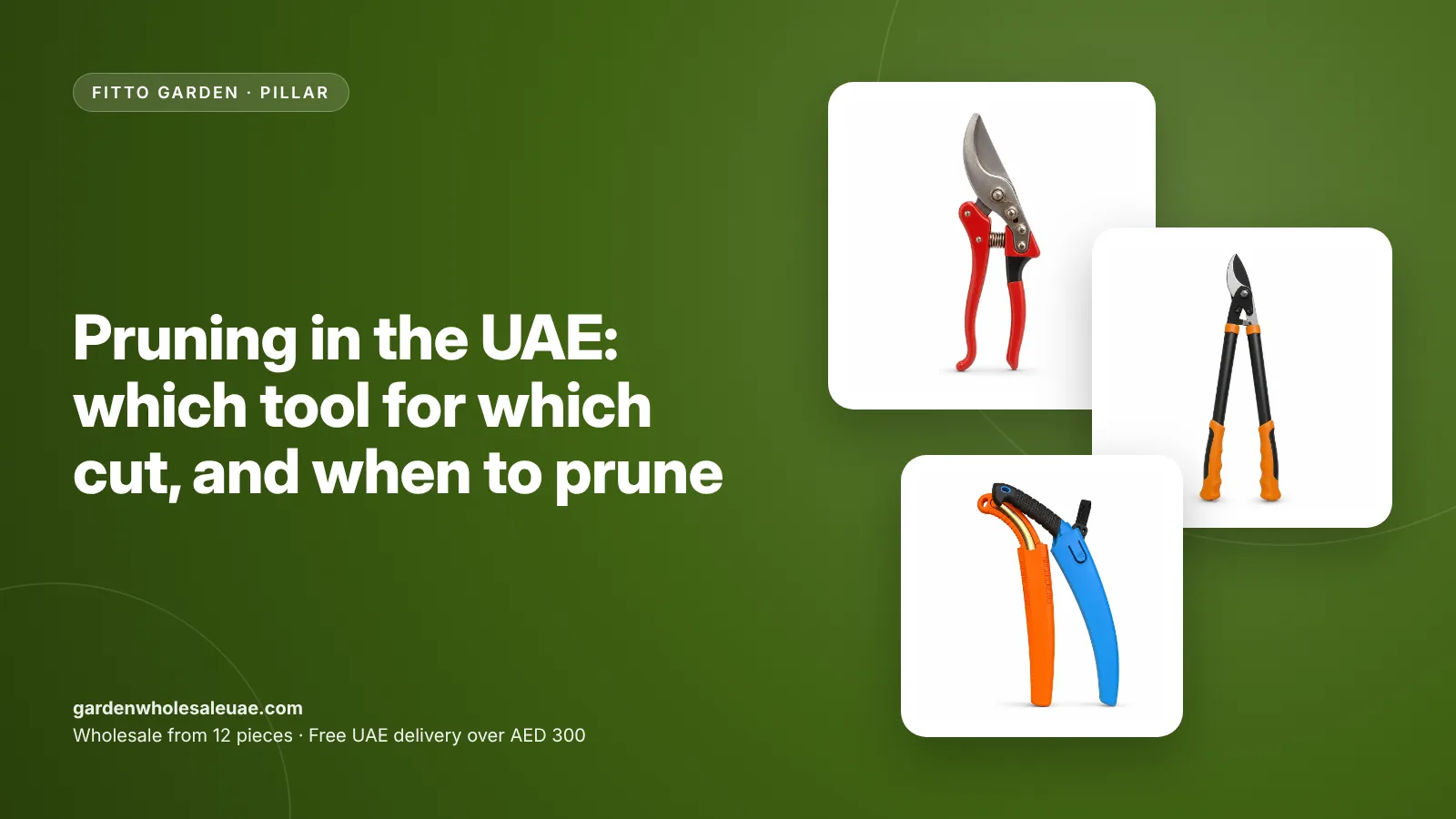
Here is the short pruning guide UAE gardeners need. Use bypass pruners on live stems up to about 20 mm, loppers up to about 40 mm and a pruning saw beyond that. Do major pruning between October and March, keep summer cuts light, and remove only dead palm fronds.
Key takeaways
- Match the tool to the stem: forcing a small tool through a thick branch tears the plant and damages the blade.
- The cooler months, roughly October to March, are the main pruning window in the UAE.
- In summer, limit pruning to dead, damaged or blocking growth, and work early in the morning.
- As a rule of thumb, remove no more than a quarter to a third of a plant's leaves in one session.
- Keep green palm fronds; cut only brown fronds and spent flower or fruit stalks.
Bad pruning in the UAE shows fast. A hedge cut hard in August scorches brown, and a bougainvillea trimmed at the wrong time stops flowering. A lopper forced through a thick branch leaves a split stub that invites pests. Each mistake costs a season of growth, and for landscapers it costs client goodwill.
This hub guide settles the two questions behind every pruning job: which tool for which cut, and when to prune each common UAE plant. It is written for home gardeners and landscapers who prune (تقليم) villas, compounds, hotels and public areas. At FITTO Garden, a wholesale gardening tools supplier in the UAE, we supply pruners, loppers, hedge shears and pruning saws to retailers, landscapers and maintenance teams.
Pruning guide UAE: which tool for which cut?
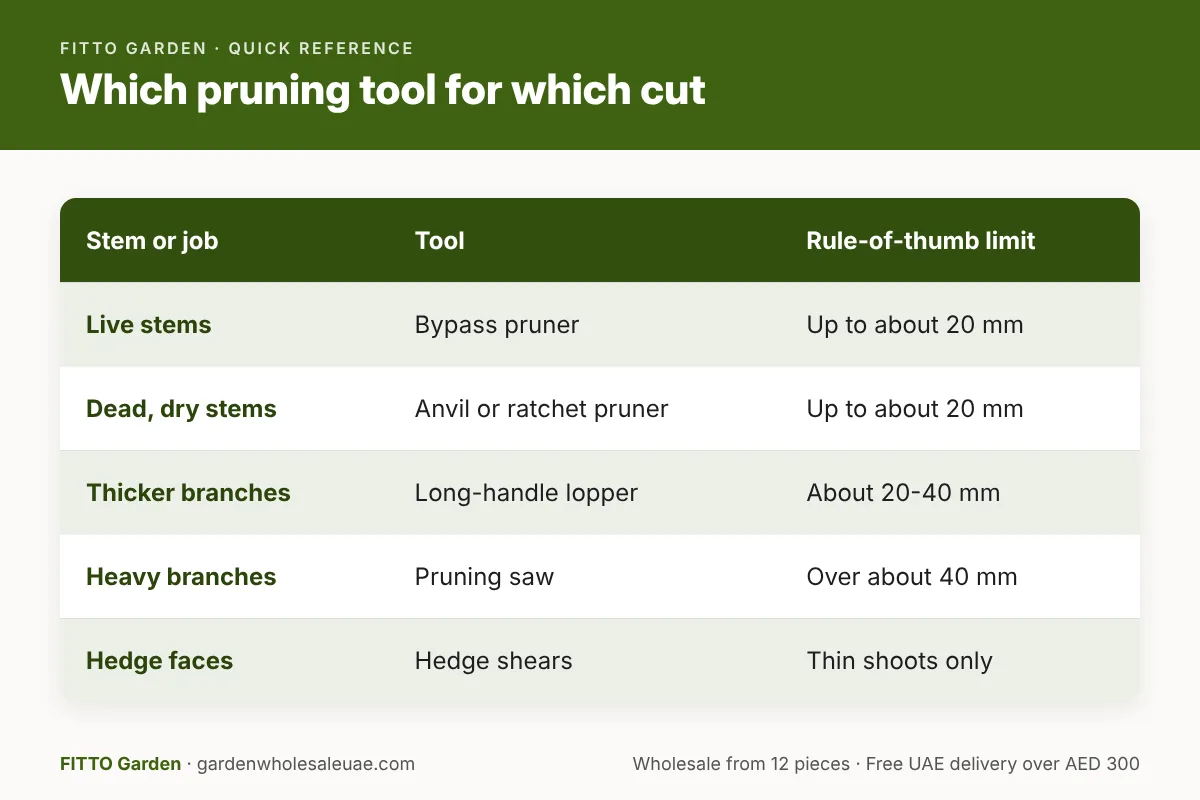
Measure the stem, then pick the tool: hand pruner to about 20 mm, lopper to about 40 mm and pruning saw above that. Hedge shears are for many thin shoots at once, not single thick stems.
The table below covers the common jobs in a UAE garden. Capacities are rules of thumb, so always check the rated capacity on the tool itself.
| Job or stem size | Right tool | FITTO example | Watch out for |
|---|---|---|---|
| Soft tips, deadheading flowers | Snips or bypass pruner | 8-inch bypass pruning shears | Pinch soft herbs by hand |
| Live stems up to about 20 mm | Bypass pruner | 8-inch bypass pruning shears (18 mm) | Do not twist the blade |
| Dead, dry stems up to about 20 mm | Anvil or ratchet pruner | Ratchet pruning shears, 20 cm | Anvils crush live tissue |
| Branches about 20-40 mm | Long-handle lopper | 60 cm bypass lopper | Keep the blade on the side you keep |
| Branches over about 40 mm | Pruning saw | 45 cm curved saw with scabbard | Use the three-cut method |
| Hedge faces and topiary | Hedge shears | 55 cm hedge shears | Thin shoots only |
| Long grass, weeds, ground cover | Grass shears or sickle | Steel grass sickle, 45 or 55 cm | Gloves and safe distance |
| Dry palm fronds and stalks | Curved pruning saw or lopper | 45 cm curved saw | Sharp spines at frond bases |
For a deeper comparison of pruner types, read our guide to bypass, anvil and ratchet pruners.
How do you make a clean pruning cut?
Cut just above a bud or side branch, at a slight angle, with the sharp blade on the side of the plant you keep. A clean cut seals quickly, which matters in UAE heat where stressed plants lose water fast.
For stems and small branches:
- Find an outward-facing bud or a side shoot growing where you want new growth.
- Cut about 5 mm above it, sloping slightly away from the bud, so water runs off.
- Remove whole branches back to the branch collar, the slightly swollen ring where the branch meets the trunk. Do not cut flush with the trunk and do not leave a long stub.
For branches too heavy to hold, use the three-cut method with a pruning saw:
- Undercut: about 30 cm from the trunk, saw upwards a third of the way through.
- Top cut: a few centimetres further out, saw down until the branch drops cleanly.
- Final cut: remove the remaining stub just outside the branch collar.
Current arboricultural advice is to leave cuts unpainted. Wound sealants can trap moisture, and a clean cut at the collar heals well without them.
When should you prune in the UAE?
Do structural and hard pruning in the cooler months, roughly October to March, and keep summer pruning light. Plants regrow strongly in mild weather, and new leaves do not face extreme sun straight away.
In summer, heavy cuts expose inner stems and bark that were shaded. They can scorch, and the plant must push new growth while already under heat stress. If you must prune between June and September, remove only dead, damaged or blocking growth, work early in the morning and water well the evening before.
| Plant | Best time in the UAE | How hard | Main tool |
|---|---|---|---|
| Roses | October-November main prune; deadhead through winter | Cut back by about a third | Bypass pruner |
| Bougainvillea | After each flowering flush; main shaping in cooler months | Light tip pruning keeps it flowering | Bypass pruner, lopper |
| Hibiscus | Late winter, around February-March | Moderate, shape and thin | Bypass pruner |
| Conocarpus and ficus hedges | Every 4-6 weeks in active growth | Light and frequent | Hedge shears |
| Date palm | After harvest; dead fronds any time | Dead fronds and stalks only | Curved saw, lopper |
| Citrus | Late winter, after harvest | Light; remove suckers any time | Bypass pruner, lopper |
| Frangipani | Late winter, before new leaves | Moderate | Pruning saw, lopper |
| Oleander | After flowering, in cooler months | Moderate | Bypass pruner, lopper |
Plants that flower on new growth, such as bougainvillea and hibiscus, respond to pruning with fresh flowering shoots. Cut them at the wrong moment, just as buds form, and you remove the coming flowers.
How much can you prune at once?
As a rule of thumb, remove no more than a quarter to a third of a plant's leaves in one session. More than that forces the plant to live on stored reserves, which is risky in UAE heat.
To reduce an overgrown shrub, spread the work over two or three cooler seasons. Each year, take out a third of the oldest stems at the base and shorten the rest. The shrub stays green while it renews itself.
Hard renovation, cutting a shrub almost to the ground, works only on tough species and only in the cooler months. If you are unsure whether a plant will regrow from old wood, ask a local nursery before cutting.
Newly planted shrubs and trees need the least pruning of all. In the first season, remove only broken, dead or crossing stems, and let the roots establish before you start shaping. Young trees benefit from one light formative prune in the cooler months, choosing a single strong leader and evenly spaced side branches.
How should you prune hedges in the UAE?
Trim hedges little and often during active growth, and shape them slightly wider at the base than at the top. A tapered profile lets sun reach the lower leaves, so the hedge stays green to the ground.
Conocarpus and ficus hedges are common in UAE villas and compounds because they grow fast. That speed means they need trimming every four to six weeks in the growing season. Let them grow a little more between trims in peak summer, and avoid cutting deep into bare wood.
Long, straight blades such as the 55 cm hedge shears with steel blades take a wide bite with each cut. Use a string line between two canes to keep the top level. Use a bypass pruner or lopper for any stem too thick for the shears, rather than forcing the blades. Our guide to loppers and hedge shears compares sizes for different hedge heights.
How should you prune palms safely?
Remove only brown, dead fronds and spent flower or fruit stalks, and leave the green crown intact. Green fronds feed the palm, and over-pruning weakens it.
A common rule of thumb is to keep every frond that sits at or above horizontal, the "nine to three o'clock" line. Cutting green fronds above that line, sometimes called a "hurricane cut", stresses the palm and can thin the trunk over time.
On date palms, cut fronds a few centimetres from the trunk with a curved pruning saw. The frond bases carry sharp spines, so wear thick gloves, long sleeves and eye protection. Palms taller than you can reach safely from the ground are a job for a professional team with proper access equipment.
Which plants need extra care when pruning?
Wear gloves for sap and thorns, and check local rules before cutting protected trees. A few common UAE plants can harm skin or are protected.
- Oleander: all parts are toxic. Wear gloves, wash tools after use and never burn the clippings.
- Frangipani and euphorbia: milky sap can irritate skin and eyes. Wear gloves and eye protection.
- Bougainvillea: sharp thorns. Use long gloves and long sleeves.
- Ghaf: the UAE's national tree is protected. Check with your municipality before any cutting beyond light trimming.
- Trees near power lines: never prune these yourself; contact the utility or a qualified contractor.
How do you keep pruning tools working?
Clean, oil and sharpen blades regularly, and disinfect them between plants when disease is present. Sand, sap and humidity dull and stick blades quickly in the UAE.
- Wipe sap and soil off blades after each session.
- Disinfect blades with alcohol between plants if you see disease.
- Oil the pivot and spring with a light oil.
- Sharpen the bevel with a fine stone when cuts start to tear.
- Store tools dry, closed and out of direct sun.
Our guide to cleaning and sharpening pruning shears covers each step in detail.
What pruning kit should gardeners and landscapers carry?
A home gardener needs a bypass pruner, a lopper and a small saw; a crew needs one pruner per person plus shared loppers, saws and hedge shears. Add gloves and a sharpening stone to every kit.
| Kit item | Home garden | Landscape crew (per team of 4) |
|---|---|---|
| Bypass pruner | 1 | 4 (one each) |
| Ratchet pruner | Optional | 1 shared |
| Long-handle lopper | 1 | 2 |
| Pruning saw with cover | 1 | 2 |
| Hedge shears | 1 if you have hedges | 2 |
| Grass sickle | Optional | 1 |
| Gloves | 1 pair | 1 pair each, plus spares |
| Sharpening stone and oil | 1 | 1 per vehicle |
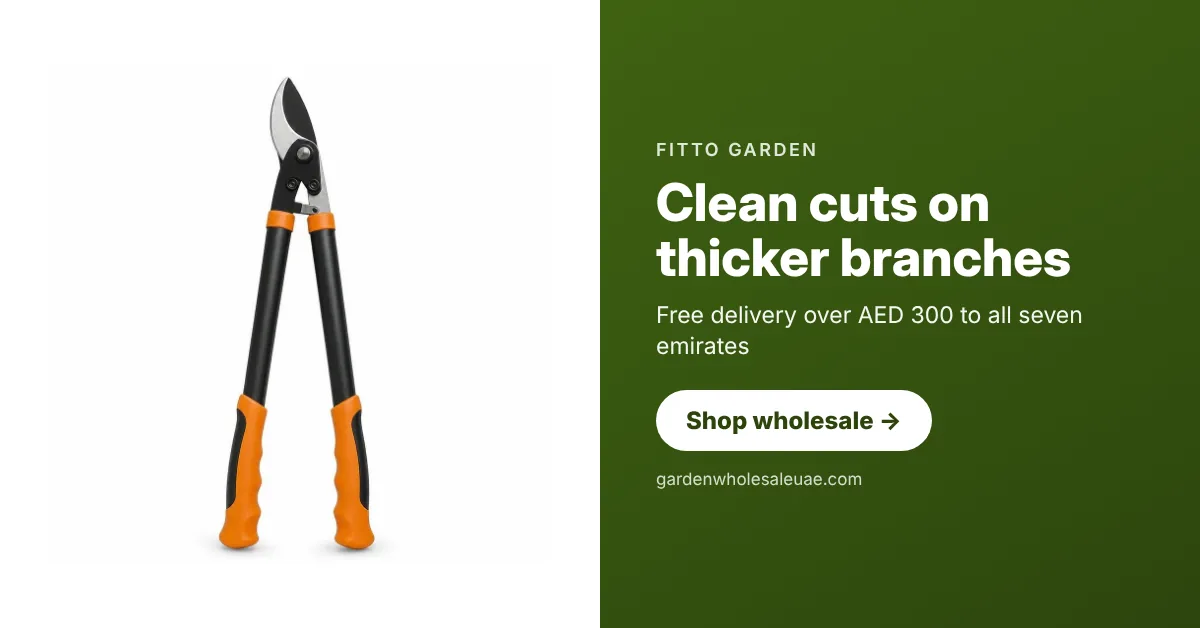
The 60 cm bypass lopper uses a curved steel bypass blade, so it cuts live branches cleanly. Pair it with the 45 cm curved pruning saw with scabbard for anything thicker.
FITTO Trade Pick: A complete pruning kit for every cut Build kits around the 8-inch bypass pruning shears (18 mm), the 60 cm bypass lopper and the 45 cm curved pruning saw. Order a sample at the single-piece price, and we credit it on a bulk order of AED 2,000+ within 30 days.
The bottom line
Pick the tool by stem thickness, cut cleanly above a bud or at the branch collar, and do the heavy work between October and March. Keep summer pruning light, leave green palm fronds alone and look after your blades, and plants recover faster with fewer losses.
Browse our wholesale gardening tools, request a quote for crew pruning kits or order a sample to test the cut. Wholesale prices start from 12 pieces, delivery is free across all seven emirates over AED 300, and our team is on WhatsApp at +971 55 672 6947. FITTO Garden: fit for the way you grow.
FAQ
What is the best month to prune in the UAE?+
For most shrubs and trees, the cooler months from October to March are best, with many gardeners doing the main prune in October or November. Roses are usually pruned as the heat breaks, and hibiscus in late winter. Avoid heavy pruning from June to September, when fresh cuts and newly exposed stems face extreme heat.
Can I prune plants in summer in the UAE?+
Yes, but keep it light. Remove dead, damaged or diseased growth and anything blocking paths or windows. Work early in the morning, water well the evening before, and avoid cutting into shaded inner stems that will suddenly face full sun. Save shaping and hard pruning for the cooler months.
How often should I trim a conocarpus hedge?+
During active growth, a conocarpus hedge usually needs trimming every four to six weeks to stay neat. Trim little and often, keep the base slightly wider than the top and let it grow a little more between trims in peak summer. Use hedge shears for the face and a bypass pruner for thicker stems.
Should I seal pruning cuts with paint?+
No, in most cases. Current advice is to leave clean cuts unpainted, because sealants can trap moisture and slow natural healing. What matters more is a clean cut with a sharp tool, made just outside the branch collar. Disinfect blades between plants if disease is present.
Which palm fronds should I cut?+
Cut only fronds that are fully brown or dry, plus spent flower and fruit stalks. Keep green fronds, especially those at or above horizontal, because they feed the palm. Wear thick gloves and eye protection, as date palm frond bases have sharp spines. Leave tall palms to a professional team with proper access equipment.
What is the thickest branch a lopper can cut?+
Most long-handle loppers handle branches up to about 40 mm, depending on the model and the wood. Check the rated capacity on the tool. If you need to twist the lopper or lean your body weight on it, switch to a pruning saw, which cuts thicker wood cleanly without crushing it.