Bypass vs anvil pruners and ratchet shears: which pruning shear suits which job?
By FITTO Trade Desk · Last updated 29 October 2026
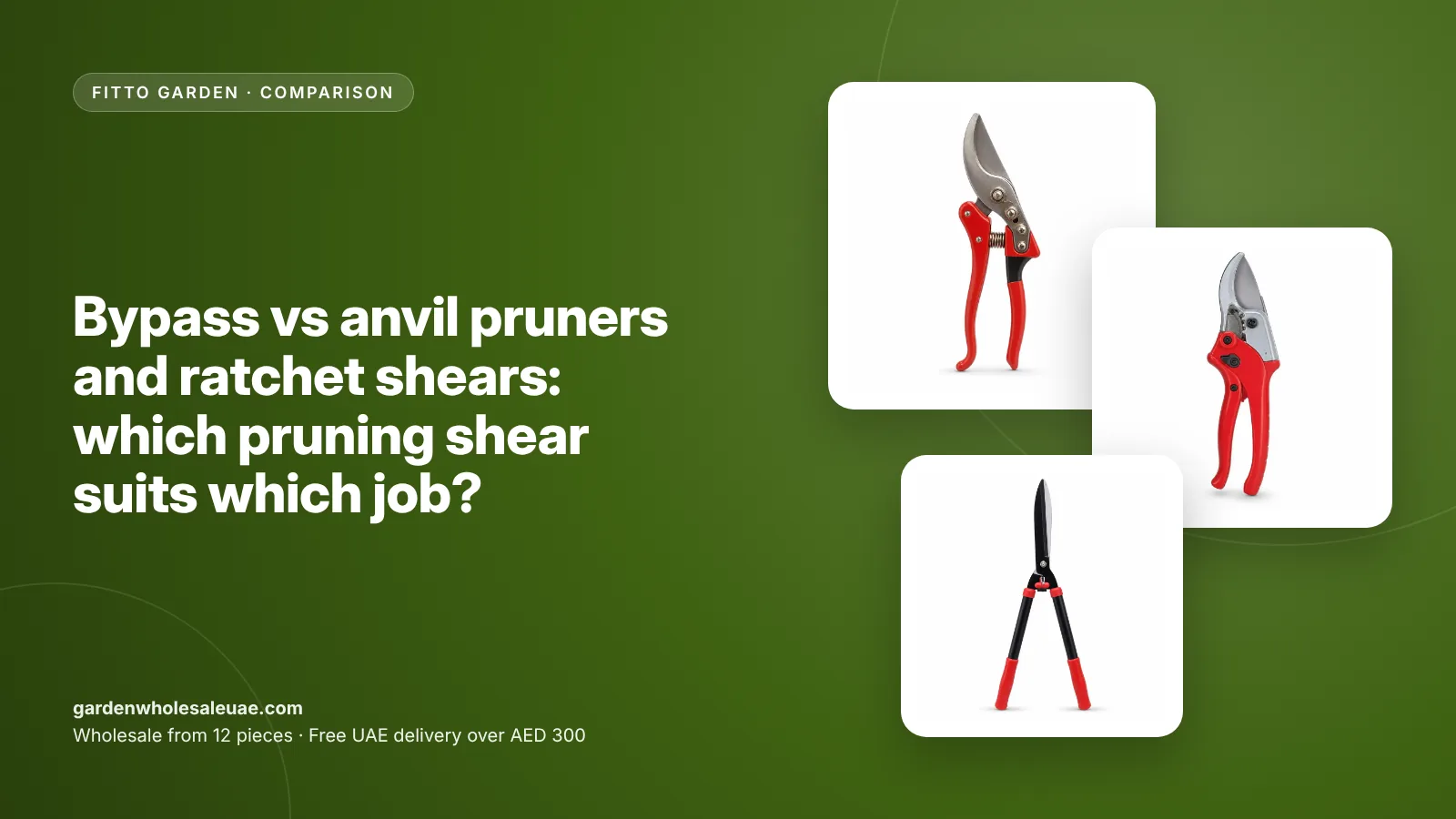
In the bypass vs anvil pruners choice, bypass pruners cut like scissors and leave a clean wound, so use them on live green stems. Anvil pruners press a blade onto a flat plate and crush slightly, so keep them for dead, dry wood. Ratchet pruners cut in stages and suit thicker stems or weaker hands.
Key takeaways
- Bypass pruners are the default for live plants: roses, hibiscus, bougainvillea and hedges.
- Anvil pruners suit dead, dry wood, where a slight crush does no harm.
- Ratchet pruners multiply hand force, which helps older gardeners and crews making hundreds of cuts.
- Hand pruners handle stems up to about 20 mm; move to a lopper or saw beyond that.
- Using an anvil on live stems bruises them, which slows healing and invites disease.
The wrong pruner does quiet damage. A crushed stem on a rose or hibiscus heals slowly, browns back and can let disease in. A bypass blade forced through thick dead wood twists and loosens. This guide explains each cutting action in one table, so you match the pruner to the job.
It is written for home gardeners and landscape crews in the UAE choosing pruning shears (مقص تقليم). At FITTO Garden, a wholesale gardening tools supplier in the UAE, we supply pruning shears, loppers and pruning saws to retailers, landscapers and maintenance companies.
How do bypass, anvil and ratchet pruners cut?
A bypass pruner slides two curved blades past each other, while an anvil pruner closes one straight blade onto a flat plate. A ratchet pruner adds a mechanism that completes the cut in two or three squeezes.
- Bypass: works like scissors. The sharp blade passes the hook-shaped lower jaw, so the stem is sliced, not squeezed.
- Anvil: works like a knife on a chopping board. The blade presses through the stem onto a flat anvil, which gives a lot of force but compresses the fibres on the anvil side.
- Ratchet: a mechanism rather than a blade type. Each squeeze advances the blade a stage, so you cut thicker stems with less grip strength. Many ratchet pruners use an anvil-style jaw, so check the blade before using one on live growth.
Bypass vs anvil pruners: how do they compare with ratchet?
Bypass wins on live growth, anvil on dead wood, and ratchet on effort. The table below sets out the trade-offs.
| Pruner type | Cutting action | Best on | Typical hand-pruner capacity | Risk on live stems | Hand effort |
|---|---|---|---|---|---|
| Bypass | Two blades pass like scissors | Live green stems, flowers, shrubs | Up to about 20 mm | Low: clean cut | Medium |
| Anvil | Blade closes on a flat plate | Dead, dry, brittle wood | Up to about 20 mm | High: crushes tissue | Medium |
| Ratchet | Cuts in stages | Thicker stems, weak grip | Up to about 20–25 mm | Depends on jaw type | Low |
Capacities vary by model, so check the rated cutting diameter on each tool; the 8-inch bypass pruning shears, for example, carry an 18 mm specification. As a rule, if you have to wrestle or twist to finish a cut, the stem is too thick for that tool.
Which pruner should you use on live UAE garden plants?
Use a bypass pruner on anything green and growing. The clean slice seals faster, which matters in UAE heat, where stressed plants dry out quickly.
Typical bypass jobs in UAE villas and hotel grounds include deadheading roses, shaping hibiscus and bougainvillea, trimming herbs and tidying conocarpus hedges. Put the sharp blade on the side of the plant you are keeping, so any slight bruising falls on the piece you remove. Cut at about 45 degrees, roughly 5 mm above an outward-facing bud.
Oleander is common in UAE gardens, and its sap is toxic, so wear gloves and wash tools after cutting it. For blade length and grip choices, our pruning shears buying guide compares 8 to 10-inch models.
When is an anvil or ratchet pruner the better choice?
Choose an anvil pruner for dead, dry wood, and a ratchet pruner when the stem is thick or the hand is tired. On dead material, crushing does no harm, and the extra force saves effort.
Good anvil jobs include clearing dead shrub branches after summer, cutting dry stems for green-waste bags and removing old flower stalks. A ratchet pruner is a sensible choice for gardeners with arthritis or a weak grip, because the staged action needs less squeeze per cut. The trade-off is speed: two or three squeezes per cut make it slower on light work.
What tool should you use for thicker branches?
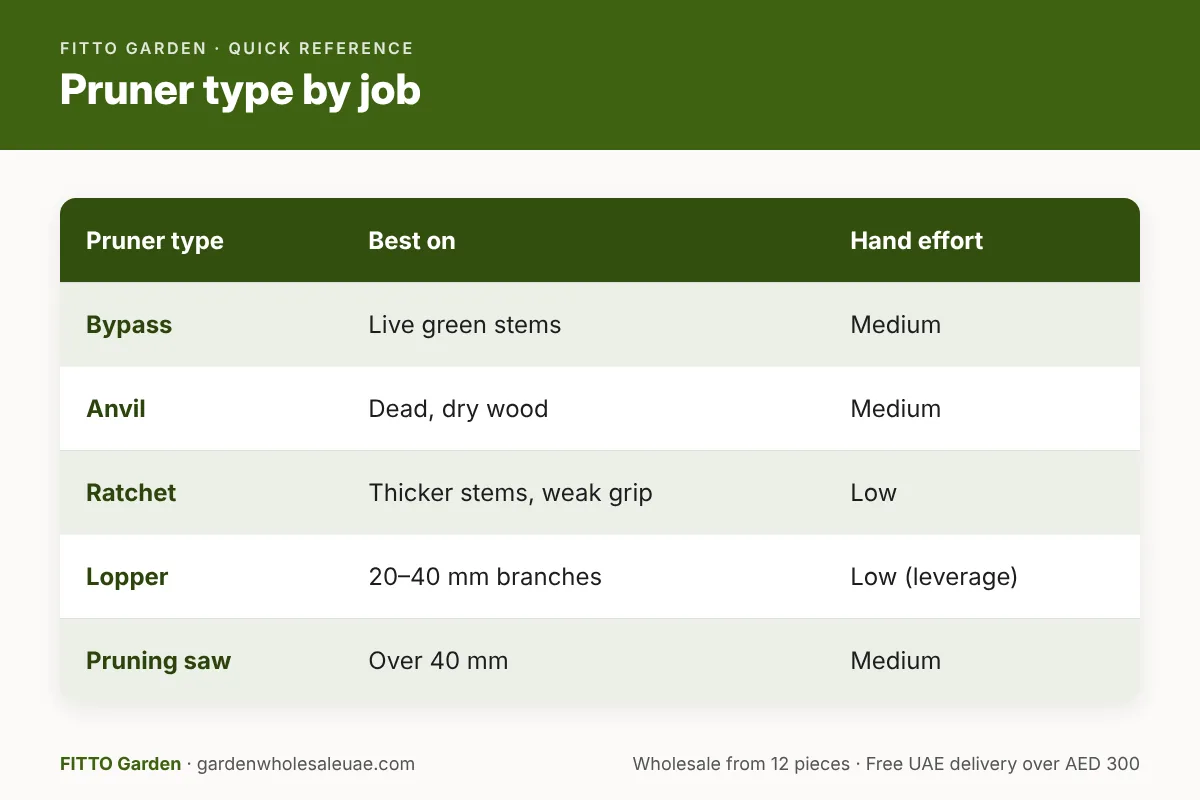
Above about 20 mm, put the hand pruner down and use a lopper; above about 40 mm, use a pruning saw. Forcing a hand pruner through a thick branch bends the blade and tears the plant.
| Branch thickness | Tool | Why |
|---|---|---|
| Up to 20 mm | Bypass pruner (live) or anvil pruner (dead) | One-handed, precise cuts |
| 20–40 mm | Long-handle lopper | Long handles give leverage |
| Over 40 mm | Pruning saw | Cuts cleanly without crushing |
| Dry palm fronds | Pruning saw or lopper | Fibrous bases jam hand pruners |
A curved blade such as the 45 cm curved pruning saw with scabbard suits overhead cuts and palm fronds, and the scabbard keeps the teeth covered on a crew belt.
How do you keep pruners cutting cleanly in UAE conditions?
Wipe, oil and dry your pruners after each session, and sharpen them before the blade starts tearing stems. Sand, sap and humidity are the main enemies of a clean cut.
- Wipe sap and dust off the blades with a damp cloth after use.
- Clean the blades with alcohol when moving between plants, to avoid spreading disease.
- Put a drop of light oil on the pivot and spring.
- Sharpen the bevelled edge with a fine stone when cuts start to tear.
- Store pruners closed and locked, in a dry place, not in a hot car.
For crews, a sensible kit is one bypass pruner per person, a shared ratchet pruner for thick stems, and a lopper and saw per team. Our guide to landscaping tools in bulk shows how to plan replacements.
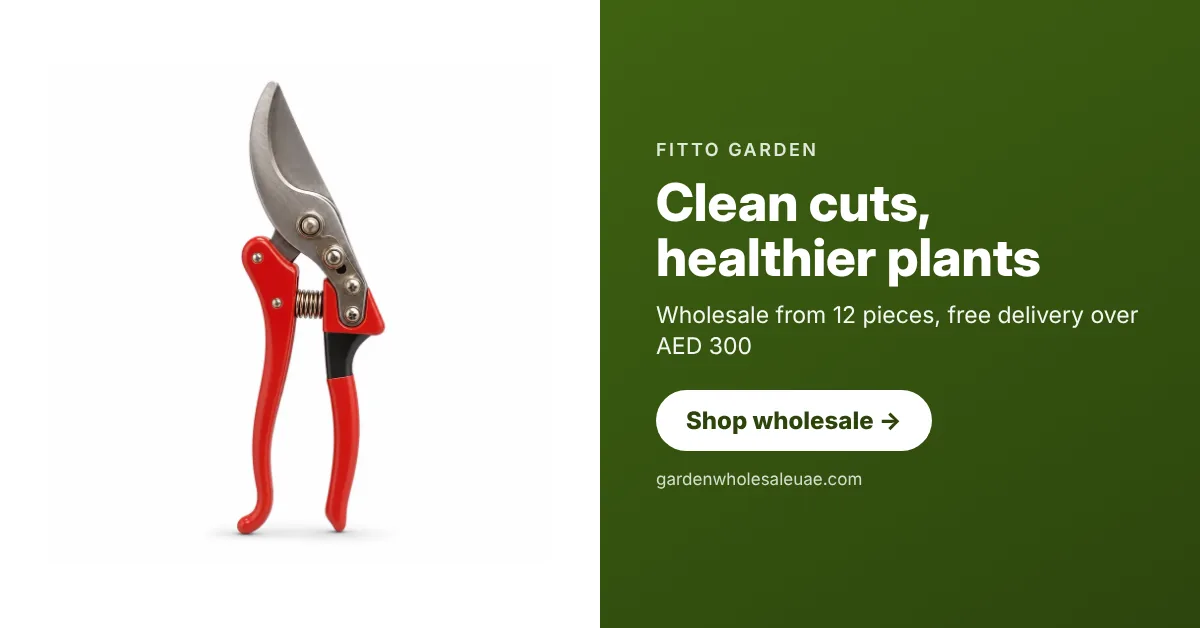
FITTO Trade Pick: The right cut for every stem Kit out crews with the 8-inch bypass pruning shears (18 mm) for live growth and the ratchet pruning shears for thicker stems for tired hands. Add the 60 cm long-handle bypass lopper for branches beyond hand-pruner size. Order a sample at the single-piece price, and we credit it on a bulk order of AED 2,000+ within 30 days.
The bottom line
Use a bypass pruner on anything alive, an anvil pruner on dead wood, and a ratchet when grip or stem thickness is the problem. Move to a lopper or saw once branches pass about 20 mm, and plants heal faster while blades last longer.
Browse our wholesale gardening tools, request a quote for crew kits or order a sample to test the cut. Wholesale prices start from 12 pieces, delivery is free across all seven emirates over AED 300, and our team is on WhatsApp at +971 55 672 6947. FITTO Garden: fit for the way you grow.
FAQ
Is bypass or anvil better for roses?+
Bypass is better for roses. The two blades slice the green stem cleanly, so the cut seals quickly and the cane is less likely to die back. An anvil pruner squeezes the stem against a flat plate and can bruise it. Keep the anvil for removing dead canes.
What is a ratchet pruner used for?+
A ratchet pruner is used for thicker stems and by gardeners with limited grip strength. Its mechanism completes the cut in two or three squeezes, so each squeeze needs less force. It is slower than a standard pruner on light work, so many gardeners keep a bypass for live growth and a ratchet for tough cuts.
What is the thickest branch a hand pruner can cut?+
Most hand pruners are designed for stems up to about 20 mm, and some ratchet models reach a little more. Check the rated cutting capacity on each tool. If you have to twist or wrestle to finish a cut, switch to a long-handle lopper, and use a pruning saw for branches over about 40 mm.
Can I use anvil pruners on live plants?+
You can, but it is not ideal. An anvil pruner crushes the fibres on the anvil side, which slows healing and can invite disease, especially on soft green stems. On live plants, use a bypass pruner instead. An anvil pruner is best kept for dead, dry or brittle wood, where crushing does no harm.
Which pruning tools should a landscape crew carry?+
A practical crew kit is one bypass pruner per worker, a shared ratchet pruner for thick stems, and a long-handle lopper and pruning saw per team. Add a sharpening stone, light oil and a cloth to the van, and replace any pruner whose blades no longer meet cleanly, because a gapped blade tears stems.