Do plant pots need drainage holes? What happens without them
By FITTO Trade Desk · Last updated 29 October 2026
Yes, almost every potted plant needs drainage holes. Without them, water pools at the bottom, roots run out of air and rot, and fertiliser salts build up. The exceptions are water plants and purpose-built self-watering pots. For a pot without holes, use it as a cachepot around a plastic pot that has them.
Key takeaways
- Drainage holes let surplus water escape, so roots get air between waterings.
- Without holes, the bottom of the pot stays soggy and root rot often follows.
- A layer of gravel at the bottom does not replace holes; it raises the wet zone.
- Pots without holes work best as cachepots, with the plant in a holed pot inside.
Do pots need drainage holes? Plant shops hear it every week, usually after a customer buys a pot with a sealed base. At FITTO Garden, a wholesale planters and plant care supplier in the UAE, we see the mistake in homes, offices and cafés alike.
What happens to a plant in a pot without drainage holes?
Water collects in the bottom of the pot, the soil there stays waterlogged, and the roots suffocate and start to rot, often before the leaves show it.
Roots need oxygen as much as water. In a sealed pot, each watering adds to a pool at the base. Fine roots there die, rot sets in, and the plant wilts even though the soil is wet.
Salts are the second problem. Fertiliser minerals normally wash out of the drainage holes (فتحات تصريف); in a sealed pot they build up and can brown leaf tips.
| Situation | Need drainage holes? | What to do |
|---|---|---|
| Houseplants, herbs, flowers, shrubs | Yes | Use a holed pot plus a saucer indoors |
| Cacti and succulents | Yes, most of all | Gritty mix and a holed pot only |
| Decorative pot with a sealed base | Use it as a cachepot | Put a holed plastic pot inside |
| Self-watering pot | Built-in overflow | Follow the reservoir fill line |
| Water plants, lucky bamboo in water | No | Change the water regularly |
Does a gravel layer at the bottom fix it?
No. Gravel at the bottom of a sealed pot drains nothing; it just moves the soggy layer higher, closer to the roots.
Water does not flow easily from fine potting mix into coarse gravel, so the soil above stays saturated. Save decorative pebbles for the top of the pot, as our guide to decorative pebbles for plant pots explains.
How do you use a cachepot safely indoors?
Keep the plant in a plain plastic pot with holes, sit it inside the decorative pot, and tip out any water that collects after watering.
- Choose an inner pot 2-3 cm narrower than the cachepot, so you can lift it out.
- Water at the sink, let it drain for 10-15 minutes, then put it back.
- If you water in place, check the cachepot after 30 minutes and pour away the surplus.
When the plant outgrows its inner pot, our guide on how to repot a plant without shock covers the move.
How do you use a saucer without drowning the plant?
Match the saucer to the base of the pot, and empty it once the pot has finished draining. Never leave a pot standing in water for hours.
A saucer as wide as the pot base, or a little wider, protects marble and parquet. Outdoors, standing water can breed mosquitoes in warm weather. Unsure how often to water? Read our list of plant watering mistakes in the UAE.
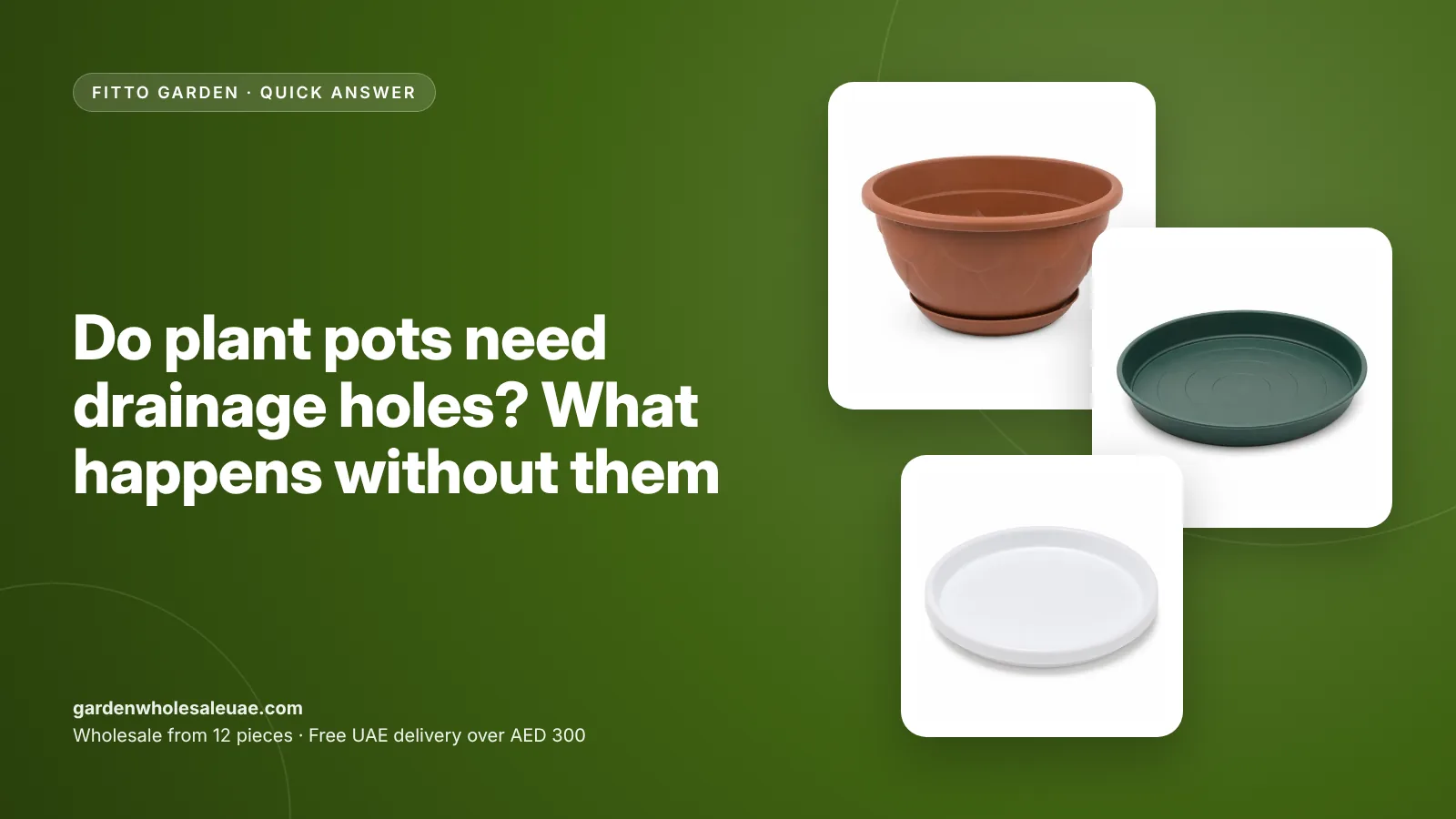
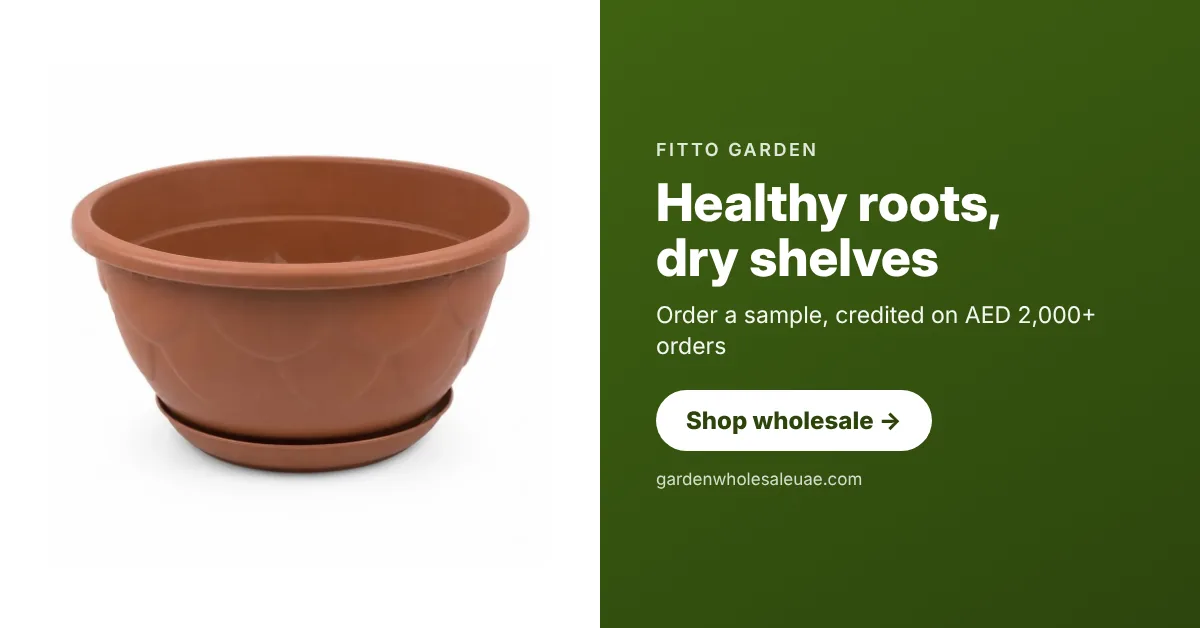
FITTO Trade Pick: Drainage that looks good on the shelf The 35 cm round bowl planter with saucer has drainage holes and a matching saucer in one set. For pots you already stock, add the 25 cm dark green plant saucer or the 40 cm rectangular drip tray for balcony troughs. Order a sample at the single-piece price, and we credit it on a bulk order of AED 2,000+ within 30 days.
The bottom line
Almost every plant you grow or sell needs a pot with drainage holes. Use sealed pots as cachepots, keep gravel out of the base and empty saucers after watering.
Browse our wholesale planters and plant care range, request a quote for your shop or order a sample first. Wholesale prices start from 12 pieces, delivery is free across all seven emirates over AED 300, and our team is on WhatsApp at +971 55 672 6947. FITTO Garden: fit for the way you grow.
FAQ
Can succulents live in pots without drainage holes?+
They can survive for a while with very careful watering, but they are the plants most likely to rot. Succulents and cacti need the soil to dry out quickly between waterings. Use a holed pot and a gritty, fast-draining mix, and place a sealed decorative pot around it if you want the look.
Can I drill drainage holes in a pot?+
Yes, in most plastic and many ceramic pots. Use a standard bit for plastic and a diamond tile bit for glazed ceramic, with masking tape over the spot and a slow speed. Keep ceramic wet and wear eye protection. As a rule of thumb, aim for at least one 1 cm hole, more in large pots.
Do self-watering pots need drainage holes?+
Self-watering pots have a reservoir under the soil and usually an overflow hole at the reservoir's top edge. That hole stops the soil flooding when the pot is overfilled or left out in rain. Fill only to the marked line, and let the reservoir run dry between refills.
Should I put the saucer under outdoor pots too?+
Outdoors, a saucer is optional. It helps on balconies and terraces where runoff would stain tiles or drip onto neighbours. Wherever you use one, empty it after watering so roots do not sit in water and mosquitoes cannot breed.