Plant feeding in the UAE: how to use fertiliser, tonics and soil boosters correctly
By FITTO Trade Desk · Last updated 29 October 2026
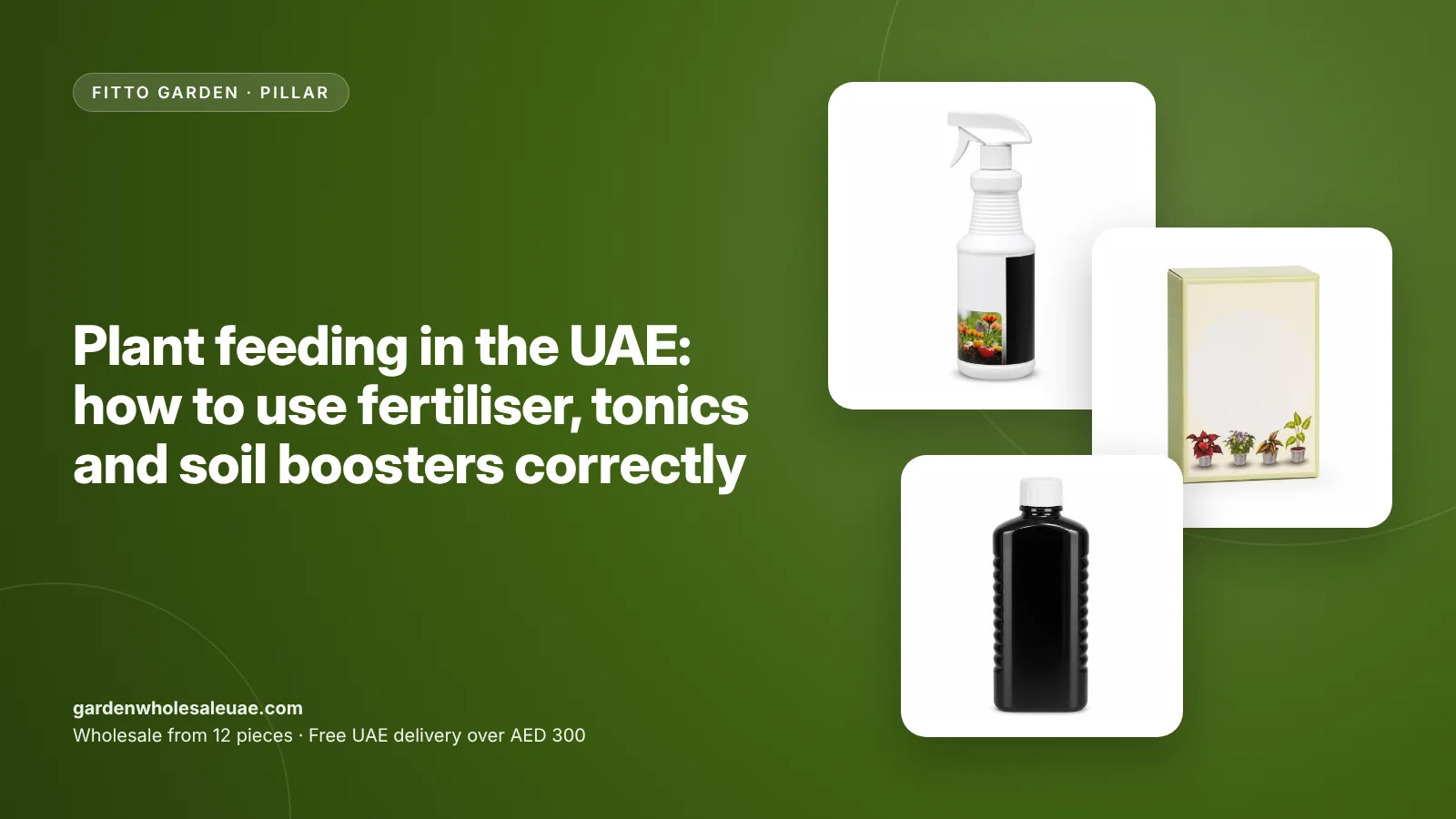
Plant fertiliser in the UAE works best little and often, on moist soil, mainly from October to April. Use a balanced liquid or slow-release feed for steady growth, an iron tonic only when young leaves yellow between green veins, and a soil booster for tired potting mix. Cut back in peak summer and flush pots regularly to stop salt build-up.
Key takeaways
- Sandy, alkaline UAE soil holds few nutrients, so plants need regular feeding, but in small doses.
- Always water first and feed second; fertiliser on dry soil is the most common cause of root burn.
- Feed fully from October to April, then reduce in June to September when heat stress slows growth.
- Yellow leaves with green veins on new growth usually point to iron shortage; old leaves yellowing evenly usually point to nitrogen.
- Flush pots with plenty of water every few weeks to wash out salts from fertiliser and tap water.
Feeding is where many UAE gardens go wrong. Plants are either starved in sandy soil, or overfed until white crust rims the pots and leaf edges brown. Both waste money on plants that then need replacing.
This guide is for home gardeners, nurseries and landscapers who want a clear system. At FITTO Garden, a wholesale planters and plant care supplier in the UAE, we stock liquid feeds, granules, tonics and soil boosters. This guide explains when each one earns its place.
What does plant fertiliser actually do?
Fertiliser (سماد) replaces the nutrients plants take from the soil, mainly nitrogen, phosphorus and potassium, plus small amounts of trace elements such as iron. It is food for growth, not a cure for poor watering, heat or the wrong plant in the wrong place.
The three main nutrients appear on most labels as an N-P-K ratio:
| Nutrient | Main job | Signs of shortage (rule of thumb) |
|---|---|---|
| Nitrogen (N) | Leafy, green growth | Older, lower leaves turn pale yellow evenly; growth slows |
| Phosphorus (P) | Roots, early growth, flowering | Weak roots, slow establishment, few flowers |
| Potassium (K) | Flowers, fruit, heat and drought tolerance | Brown, scorched leaf edges on older leaves |
| Iron (Fe), a trace element | Making green chlorophyll | Young leaves yellow between green veins |
A high first number suits lawns and leafy plants. Flowering and fruiting plants generally do better with a feed that is not nitrogen-heavy, because too much nitrogen gives lush leaves and fewer blooms. Bougainvillea is a classic example in UAE villas.
Why do UAE plants need feeding differently?
UAE soil is mostly sand: it drains fast, holds few nutrients and is usually alkaline. That combination means nutrients wash away quickly and some, especially iron, become hard for roots to absorb.
Four local conditions shape every feeding plan:
- Sandy soil. Water and dissolved nutrients drain straight through, so feeding little and often beats one heavy dose.
- High pH. Most garden soil here is alkaline. Iron and some other trace elements become less available, which is why yellowing citrus and gardenias are so common.
- Salts. Irrigation water and fertiliser both leave salts behind. In pots, with no rain to flush them, salts build up fast.
- Heat. From June to September, many plants slow down to survive. Pushing them with strong feed then adds stress rather than growth.
The practical answer is to improve the soil as well as feed the plant. Organic matter, such as compost or a natural powder feed, helps sandy soil hold water and nutrients for longer. Our guide to plant pots and planters in the UAE covers potting mix and drainage, which matter as much as the feed itself.
Which type of plant feed should you use?
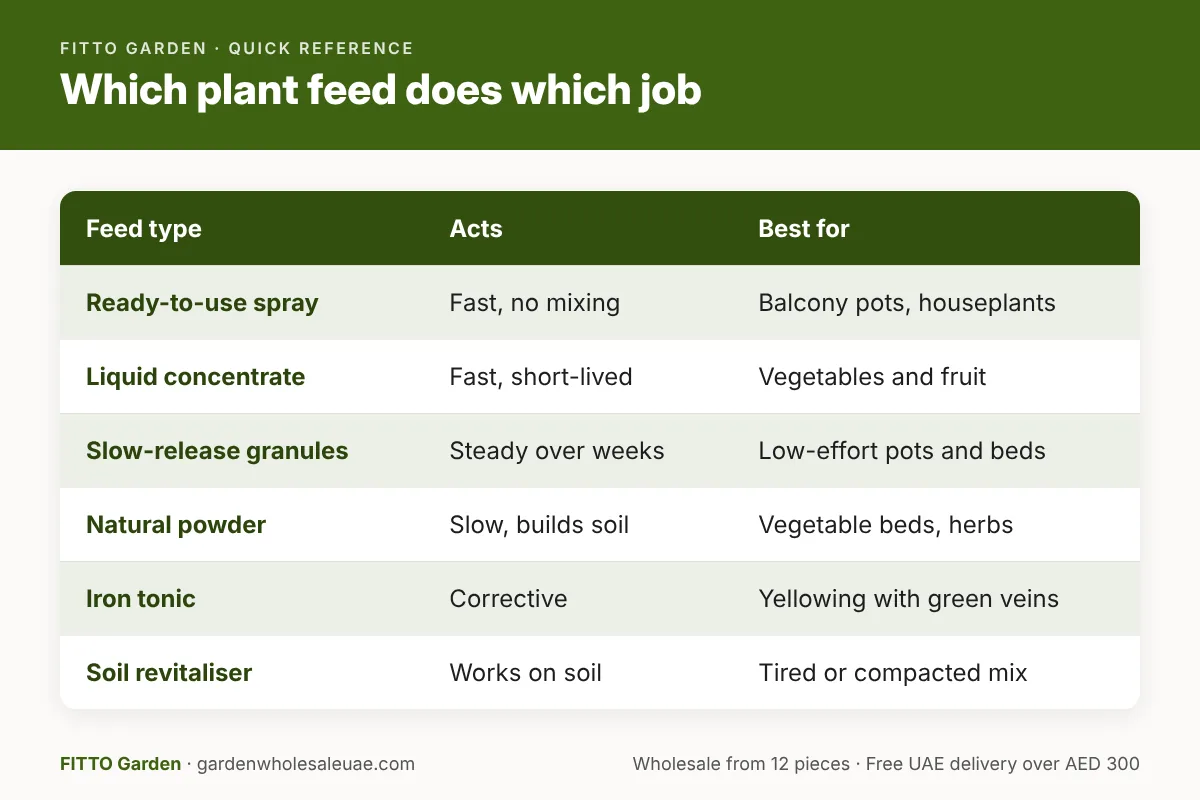
Choose by how fast you need results and how much effort you want: liquids act fast, granules last longer, and natural powders build the soil. Most gardens use two types together.
| Type | How it works | Best for | FITTO example |
|---|---|---|---|
| Ready-to-use spray | Sprayed onto soil or plants as the label directs; no mixing | Balcony pots, houseplants, busy owners | Plant growth fertiliser spray, 750 ml |
| Liquid concentrate | Diluted in a watering can; fast-acting, short-lived | Vegetables, fruit, regular feeding schedules | Biotic liquid fertiliser for vegetables and fruit, 1 L |
| Slow-release granules | Sprinkled on the soil; release nutrients over weeks | Pots and beds that need steady feeding with little effort | Slow-release granular fertiliser, boxed |
| Water-soluble granules | Sprinkled or dissolved, as the label directs | Mixed indoor and outdoor plants, lawns | Blue granular fertiliser in a clear jar |
| Natural powder | Mixed into soil; feeds slowly and adds organic matter | Vegetable patches, herbs, fruit trees | Natural powder fertiliser; neem herbal powder |
| Iron tonic | Supplies iron for green leaves | Yellowing between green veins on new leaves | Iron tonic plant supplement, 500 ml |
| Soil revitaliser | Works on the soil rather than the leaves | Old potting mix, compacted or tired beds | Soil revitaliser liquid, 1 L |
A sensible home kit is one fast feed and one slow feed. For example, pair the ready-to-use plant growth fertiliser spray for flowers and vegetables with the slow-release granular plant fertiliser. Add an iron tonic only if you see the yellowing pattern described below.
Ready-to-use sprays cost more per dose than concentrates but remove dosing mistakes, which suits a few balcony pots. For a large garden or nursery bench, concentrates and granules are more economical.
How do you read the label and dose correctly?
Follow the label dose exactly, and when in doubt, use less rather than more. A weaker feed given more often is safer in sandy soil and hot weather than a strong feed given once.
Use this routine for liquid and granular feeds:
- Read the label for the plant type. Note the dose, the dilution (for concentrates) and how often to repeat.
- Water the plant first. Soil should be moist, not dry, before any fertiliser touches the roots.
- Measure, do not guess. Use the cap or a measuring cup for liquids, and a spoon for granules.
- Apply to the soil around the root zone, keeping granules a few centimetres away from the stem.
- Water lightly again after granules, so they settle and begin to dissolve.
- Record the date on a plant label or phone note, so you do not feed twice by mistake.
Ready-to-use sprays skip the dilution step, but the label still sets the frequency. The plant tonic spray for green foliage and flowering, for example, is labelled for once-a-week use. Wear gloves for concentrates, wash hands afterwards, and store all products closed, upright and out of reach of children and pets.
When should you feed plants across UAE seasons?
Feed most from October to April, when temperatures suit growth, and cut back from June to September. The cooler months are the UAE's real growing season for vegetables, flowers and new planting.
| Months | Typical conditions | Feeding approach |
|---|---|---|
| October to November | Heat easing; main planting window opens | Mix natural powder or slow-release granules into beds before planting; start liquid feeds two to three weeks after planting |
| December to February | Mild days, cool nights | Regular feeding at the full label rate for vegetables, flowers and lawns |
| March to April | Warming up; peak flowering and harvest | Continue feeding; favour flower and fruit feeds; flush pots once a month |
| May | Heat building | Reduce strength or frequency; finish feeding annual crops |
| June to September | Extreme heat and humidity | Feed only actively growing plants at reduced strength, early morning or evening; flush pots more often |
These are rules of thumb, not fixed dates. Indoor plants in air-conditioned rooms grow more evenly all year, so they can keep a light feeding schedule through summer. For what to sow and when, see our winter planting guide for the UAE.
Never feed a plant that is wilting from heat; water it, let it recover, and feed later if at all. Avoid spraying any product on leaves in midday sun, because droplets on hot leaves can scorch them.
How do you avoid salt build-up and root burn?
Water before feeding, never exceed the label dose, and flush pots with a deep watering every few weeks. These three habits prevent most fertiliser damage.
Root burn happens when fertiliser salts are too concentrated around the roots. Signs include brown, crispy leaf tips and edges, sudden wilting after feeding, and white or yellow crust on the soil surface or pot rim. In pots, the problem builds up gradually, because salts from tap water and feed have nowhere to go.
To flush a pot:
- Take the pot to a drain, a balcony tray or a garden bed.
- Water slowly until water runs freely from the drainage holes.
- Keep going with about the same volume again, so the excess salts leave with the water.
- Let the pot drain fully, and empty the saucer so the plant does not sit in salty water.
As a rule of thumb, flush outdoor pots once a month in the cooler season and every two weeks in summer. Pots must have drainage holes for this to work. If the crust keeps returning, scrape off the top centimetre of mix and replace it with fresh potting soil. Our guide on how often to water plants in a UAE summer explains deep watering versus little sips.
A soil revitaliser liquid is useful after flushing old pots or compacted beds, because it works on the soil itself. Use it at the label dilution on moist soil.
Why are leaves turning yellow, and does iron tonic help?
Iron tonic helps only when the pattern is right: young leaves turning yellow while their veins stay green. Other yellowing usually has a different cause, and extra iron will not fix it.
| What you see | Likely cause (rule of thumb) | What to do |
|---|---|---|
| New leaves yellow, veins stay green | Iron shortage, common in alkaline soil | Apply iron tonic as the label directs; repeat as directed |
| Old, lower leaves yellow evenly | Nitrogen shortage | Use a balanced feed; check you are feeding at all |
| Yellow leaves, wet soil, sour smell | Overwatering or poor drainage | Water less; check drainage holes; do not feed until it recovers |
| Brown, crisp leaf edges and white crust | Salt build-up or overfeeding | Flush the pot; pause feeding; resume at a lower rate |
| Pale, stretched growth indoors | Too little light | Move closer to a bright window; feeding will not help |
The iron tonic plant supplement for yellowing leaves suits citrus, roses, herbs and potted plants showing that classic vein pattern. Expect new leaves to come through greener; leaves that are already badly yellow may not fully recover.
If many plants yellow at once, test the soil pH or ask a local nursery or landscape professional before buying more products.
How should you feed common UAE garden plants?
Match the feed to what you want from the plant: leaves, flowers or fruit. Here is a practical starting point for the plants most UAE gardens grow.
- Vegetables and herbs (tomatoes, cucumbers, peppers, leafy greens): mix a natural powder fertiliser into the bed before planting. Once plants establish, use a liquid feed for vegetables and fruit at the label interval.
- Roses, jasmine and flowering pots: a flower feed such as the rose and flower fertiliser spray through the cooler months, with iron tonic if new leaves yellow.
- Bougainvillea: feed lightly. Too much nitrogen gives leaves instead of colour; mild stress often brings more bracts.
- Citrus and fruit trees: steady feeding from late winter through spring, and watch closely for iron yellowing.
- Lawns: feed in the cooler growing months; never feed a lawn that is dry or heat-stressed.
- Houseplants: light, regular feeding in the growing season; wipe dust from leaves so they get the most from the light.
Neem powder appeals to vegetable growers who prefer a natural option. The neem herbal powder fertiliser is labelled to enrich soil and help repel insects; treat it as soil care, not a guaranteed pest cure.
What should nurseries and landscapers keep in stock?
Stock by job, not by brand: one fast feed, one slow feed, one corrective tonic and one soil booster cover most customer questions. Clear signage reduces wrong purchases and returns.
For a nursery counter, group products into three shelf messages: "Feed" (sprays, liquids, granules), "Fix" (iron tonic) and "Soil" (revitaliser, natural powders). Place the 3-litre pressure sprayer and watering cans nearby for customers using concentrates. Our article on plant shop add-on sales covers placement in more detail.
Landscape crews save with concentrates and granules, and a feeding log per site stops crew members double-dosing the same beds.
FITTO Trade Pick: A complete feed, fix and soil range Build your shelf around the plant growth fertiliser spray, the slow-release granular fertiliser and the iron tonic for yellowing leaves. Packs start at 12 pieces, with up to 20% lower cost per piece on 144.
The bottom line
In the UAE, feed plants little and often on moist soil, mainly from October to April, and cut back in summer heat. Use iron tonic only for the green-vein yellowing pattern, and flush pots regularly so salts never build up. That routine keeps plants green without wasting product.
Browse our wholesale planters and plant care range, request a quote for a nursery or landscape order, or order a sample to test a product first. Delivery is free across all seven emirates over AED 300, and our team answers on WhatsApp at +971 55 672 6947. FITTO Garden: fit for the way you grow.
FAQ
How often should I fertilise plants in the UAE?+
Follow the product label first. As a general rule, liquid feeds are repeated every one to two weeks in the growing season, and slow-release granules every few weeks to months. Feed most from October to April, and reduce strength or frequency from June to September.
Can I fertilise plants in summer?+
Yes, but carefully. Feed only plants that are actively growing, use a weaker dose, and apply it early in the morning or in the evening on moist soil. Never feed a plant that is wilting from heat. Indoor plants in air-conditioned rooms can usually keep a light feeding schedule through summer.
Why do my pots have a white crust on the soil?+
A white or yellowish crust is usually salt left behind by tap water and fertiliser as water evaporates. Flush the pot by watering slowly until plenty of water drains out, scrape off the crusty top layer and replace it with fresh mix. Pause feeding for a few weeks, then resume at a lower rate.
Is liquid or granular fertiliser better?+
Neither is better in every case. Liquid feeds act quickly and suit regular schedules and hungry vegetables. Slow-release granules feed steadily with less effort, which suits busy owners and holidays. Many gardeners use both: granules as the base, with a liquid feed during peak growth or flowering.
Can too much iron tonic harm plants?+
Yes. Any supplement used above the label dose can stress roots or mark leaves, and it will not fix yellowing caused by overwatering or salt. Use iron tonic only for the green-vein pattern on young leaves, follow the label dose and interval, and give the plant a few weeks to show greener new growth.