Liquid vs granular fertiliser: which suits pots, lawns and vegetables?
By FITTO Trade Desk · Last updated 29 October 2026
In the liquid vs granular fertiliser choice, liquid acts within days and suits pots, seedlings and quick fixes, but lasts only one to two weeks. Granular, especially slow-release, acts slower but feeds for weeks or months, which suits lawns, beds and busy pot owners. Most gardens do best with both.
Key takeaways
- Liquid fertiliser is fast and easy to dose in pots, but needs repeating every week or two.
- Slow-release granules feed for weeks or months from one application, with the lowest burn risk.
- In sandy UAE soil, liquid feed washes through quickly, so beds and lawns favour granules.
- Burn comes from overdosing or feeding dry soil, whichever type you use.
- A practical routine is granules as the base and liquid as the boost.
Pick the wrong fertiliser (سماد) and you either feed too slowly to help or so strongly that roots scorch. Nurseries then field customers asking about brown leaf tips.
This comparison sets out speed, duration, cost per feed and burn risk, then gives a verdict for each plant group. It is written for home gardeners and nurseries that advise them. At FITTO Garden, a wholesale planters and plant care supplier in the UAE, we stock both liquid and granular feeds, so the advice below is not tilted towards one type.
What is the difference between liquid and granular fertiliser?
Liquid fertiliser is dissolved nutrients that roots or leaves take up straight away. Granular fertiliser is solid pellets that release nutrients into the soil as they dissolve or break down.
Liquids come as concentrates you dilute in a watering can, or as ready-to-use trigger sprays. Granules come in two main kinds. Quick-release granules dissolve within a few waterings. Slow-release granules are designed to let nutrients out gradually over weeks or months.
Some granules do both jobs: our blue granular fertiliser can be sprinkled or dissolved in water, as its label directs. Read the label, because "granular" covers very different release speeds.
Liquid vs granular fertiliser: how do they compare?
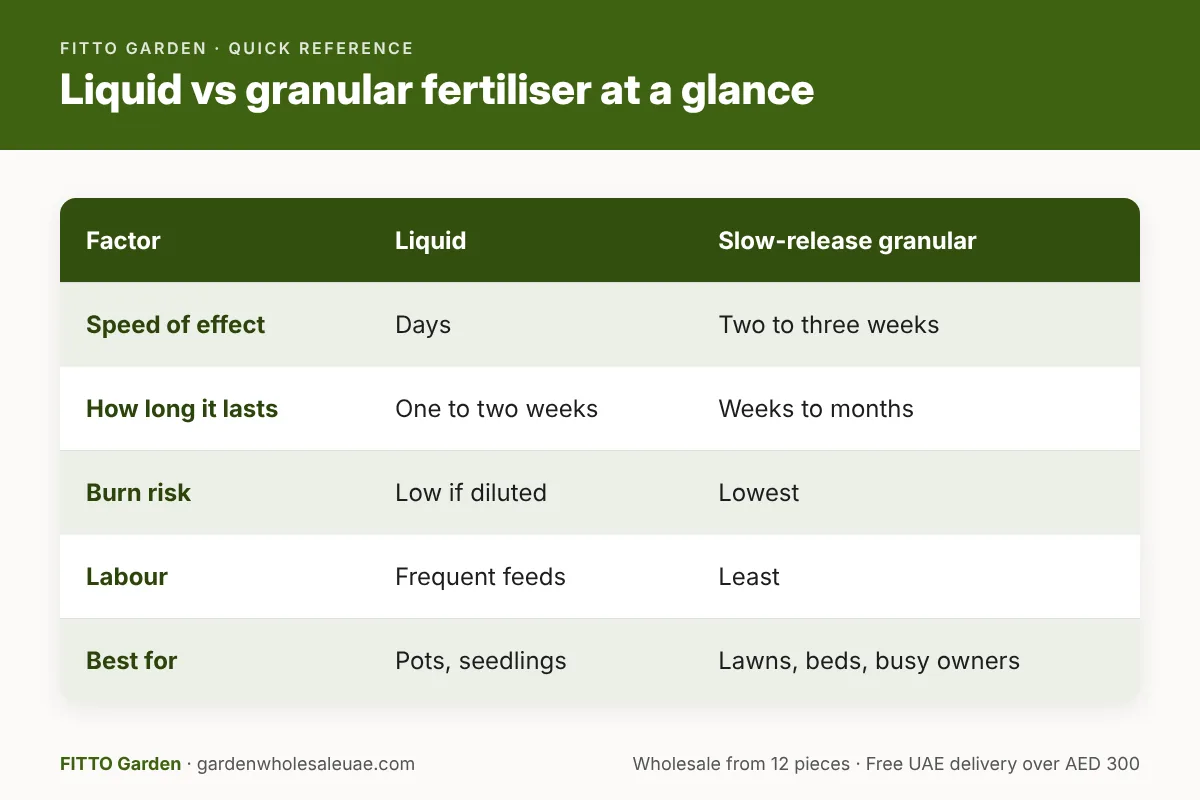
Liquid wins on speed and control in pots. Slow-release granular wins on duration, labour and burn safety. Quick-release granular sits in between.
| Factor | Liquid | Quick-release granular | Slow-release granular |
|---|---|---|---|
| Speed of effect | Days | One to two weeks | Two to three weeks |
| How long it lasts | One to two weeks | A few weeks | Weeks to months, per label |
| How you apply | Dilute and water, or spray | Spread, then water in | Spread or mix in once |
| Burn risk | Low if diluted correctly | Higher if overdosed | Lowest |
| Labour | Frequent | Moderate | Least |
| Best for | Pots, seedlings, quick fixes | Lawns, beds | Containers, terraces, busy owners |
These timings are rules of thumb. Temperature, watering and the product's own formula all change them, so the label dose and interval always come first.
Which is cheaper per feed?
Concentrated liquids and granules are both economical per feed. Ready-to-use sprays are the most convenient but cost the most per feed, because you are paying for the water too.
A 1 L concentrate diluted in a watering can covers many feeds. A 750 ml ready-to-use spray is ideal for a few houseplants, but it runs out fast on a balcony full of pots. Slow-release granules usually cost least in labour, which matters most for nurseries and landscapers paying for staff time.
For a watering can that makes dilution easy, our watering can buying guide compares sizes and spouts.
What causes fertiliser burn and how do you avoid it?
Burn happens when too much fertiliser salt sits around the roots and draws water out of them. It shows as brown leaf edges, wilting in moist soil and a white crust on the soil surface.
Both types can burn; the cause is nearly always the dose or the timing. Follow these steps:
- Water the plant first, then feed; never feed bone-dry soil.
- Use the label dose, or half strength for houseplants and seedlings.
- Keep granules off leaves and away from the stem.
- Water granules in after spreading, especially on lawns.
- Flush pots with plain water every few weeks in summer to wash out built-up salts.
If you see burn, stop feeding and water thoroughly to wash salts through.
Which fertiliser suits pots, lawns and vegetables?
Pots favour liquid or slow-release granules, lawns favour granules, and vegetables do best with granules mixed in at planting plus liquid feeds when fruiting.
| Plant group | Best choice | Typical routine (follow the label) | Why |
|---|---|---|---|
| Houseplants | Liquid at half strength, or slow-release | Every 2-4 weeks in growth | Easy to dose small pots |
| Terrace and balcony pots | Slow-release granular, liquid boost | Granules each season | Pots dry fast; fewer feeds needed |
| Lawns | Granular with a spreader | Per label, watered in | Even cover over large areas |
| Vegetables | Granular or powder at planting, then liquid | Liquid every 1-2 weeks when fruiting | Steady base plus quick boosts |
| Flowering shrubs and roses | Granular base, bloom liquid | Granules in the cooler months | Too much nitrogen gives leaves, not flowers |
| Seedlings and new transplants | Weak liquid only | After roots settle | Granules can scorch young roots |
UAE soil adds two local twists. Sandy soil holds little water, so liquid feeds wash past the roots quickly; granules and organic matter hold nutrients for longer. Alkaline soil and water also make iron harder for plants to take up. That shows as yellow leaves with green veins on citrus, gardenia and roses, and a liquid iron supplement is the quick fix.
Most vegetable growing in the UAE happens in the cooler months. Our guide to winter planting in the UAE covers timing, and the plant fertiliser and feeding guide goes deeper on nutrients and labels.
Should you use both liquid and granular fertiliser?
Yes, for most gardens. Use slow-release granules as the steady base and a liquid feed as a short-term boost for flowering, fruiting or recovery.
A simple pattern for pots and beds is granules at the start of the season, then a liquid feed every two to three weeks while plants are actively growing. In the hottest weeks of summer, many plants slow down, so feed lightly or pause. For nurseries, stocking one slow-release granule, one liquid concentrate and one iron supplement covers most customer questions.
FITTO Trade Pick: Granules for the base, liquid for the boost Stock the slow-release granular plant fertiliser for low-effort feeding and the 1 L biotic liquid fertiliser for vegetables and fruit for quick boosts. Add the 750 ml plant growth fertiliser spray and the 500 ml iron tonic for yellowing leaves as easy counter sales. Order a sample at the single-piece price, and we credit it on a bulk order of AED 2,000+ within 30 days.
The bottom line
Use liquid fertiliser where you need speed and control, and slow-release granules where you want steady feeding with less work. Combine them, follow the label and water before feeding, and burn is rarely a problem.
Browse our wholesale planters and plant care range, request a quote for your nursery or shop, or order a sample to test a product first. Wholesale prices start from 12 pieces, delivery is free across all seven emirates over AED 300, and our team is on WhatsApp at +971 55 672 6947. FITTO Garden: fit for the way you grow.
FAQ
Is liquid or granular fertiliser better for potted plants?+
Both work. Liquid is easy to dose accurately in small pots and acts within days, so it suits houseplants and seedlings. Slow-release granules suit larger pots and busy owners, because one application feeds for weeks. Many container gardeners use granules as a base and add a weak liquid feed while plants are growing.
How long does slow-release granular fertiliser last?+
It depends on the product and on temperature, so check the label. Many slow-release granules are designed to feed for several weeks to a few months. In hot weather and with frequent watering, nutrients tend to release faster, so plants in UAE summer conditions may need topping up sooner than the maximum stated.
Can I use granular fertiliser on vegetables?+
Yes. Mix granular or powder fertiliser into the bed or potting mix before planting, at the label dose, to give a steady base. Once plants such as tomatoes and cucumbers start flowering and fruiting, add a liquid feed every one to two weeks. Keep granules away from stems and young roots.
Why are my plant leaves yellow after feeding?+
Yellow leaves soon after feeding can point to overfeeding and salt build-up, especially if the edges turn brown. Flush the pot with plain water and pause feeding. Yellow leaves with green veins usually point to iron deficiency, which is common in alkaline UAE soil and responds to a liquid iron supplement.
Can I apply fertiliser in the summer heat?+
You can, but feed lightly and at the right time. Water first, apply in the early morning or evening, and avoid feeding plants that are already wilting from heat. Many plants grow slowly in peak summer, so they need less fertiliser than in the cooler months.