Rechargeable headlamp UAE buying guide: lumens, fit and charging for camping and night work
By FITTO Trade Desk · Last updated 29 October 2026
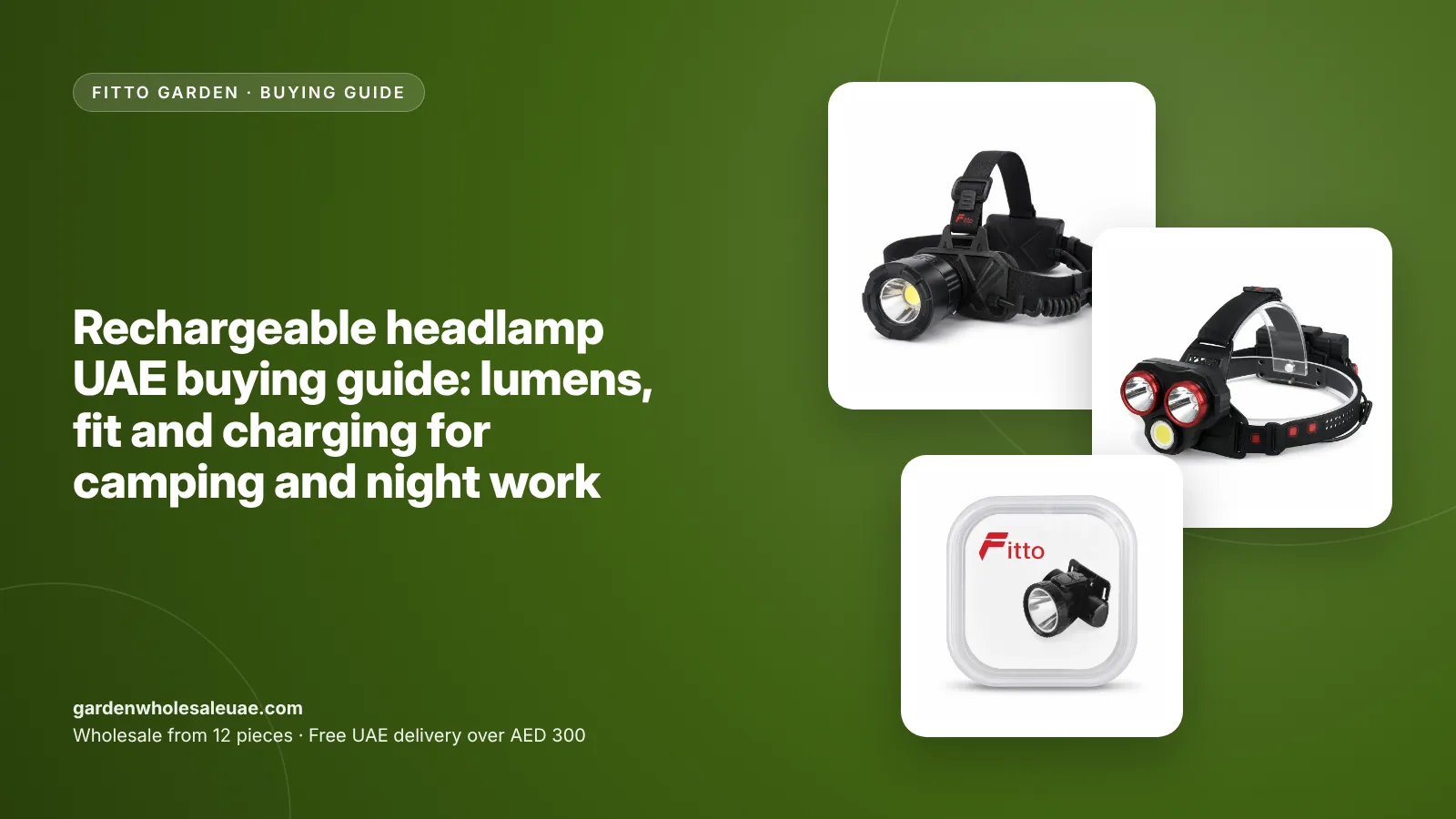
The right rechargeable headlamp for UAE trips and night work gives about 100-300 lumens for camp tasks and 300 or more for trails, shore fishing and repairs. It should have a red mode, a wide adjustable strap and a tilting head. Check the water rating and charging port before buying, and never store it in a hot car.
Key takeaways
- Brightness is measured in lumens; watts describe power use, so compare like with like.
- Most camp jobs need 100-300 lumens; brighter modes drain the battery much faster.
- A wide strap, tilting lamp and balanced weight matter more than peak brightness on a long night.
- IPX4 handles splashes and rain; anglers and beach users should look for a higher rating.
- Summer car cabins can climb well above 60 °C, which shortens battery life.
A torch in one hand leaves one hand for the tent peg, the fishing knot or the pump fitting. Then the torch slips into the sand, and the job takes twice as long. A good headlamp (مصباح رأس) fixes that, but a poor one pinches, dazzles your friends and dies at 10 pm. This guide is for campers, anglers and maintenance teams choosing a hands-free light for desert camps, beach nights and late call-outs.
At FITTO Garden, a wholesale camping and outdoor gear supplier in the UAE, we explain the numbers on the box so you can choose by job rather than by the biggest figure.
How many lumens does a headlamp need?
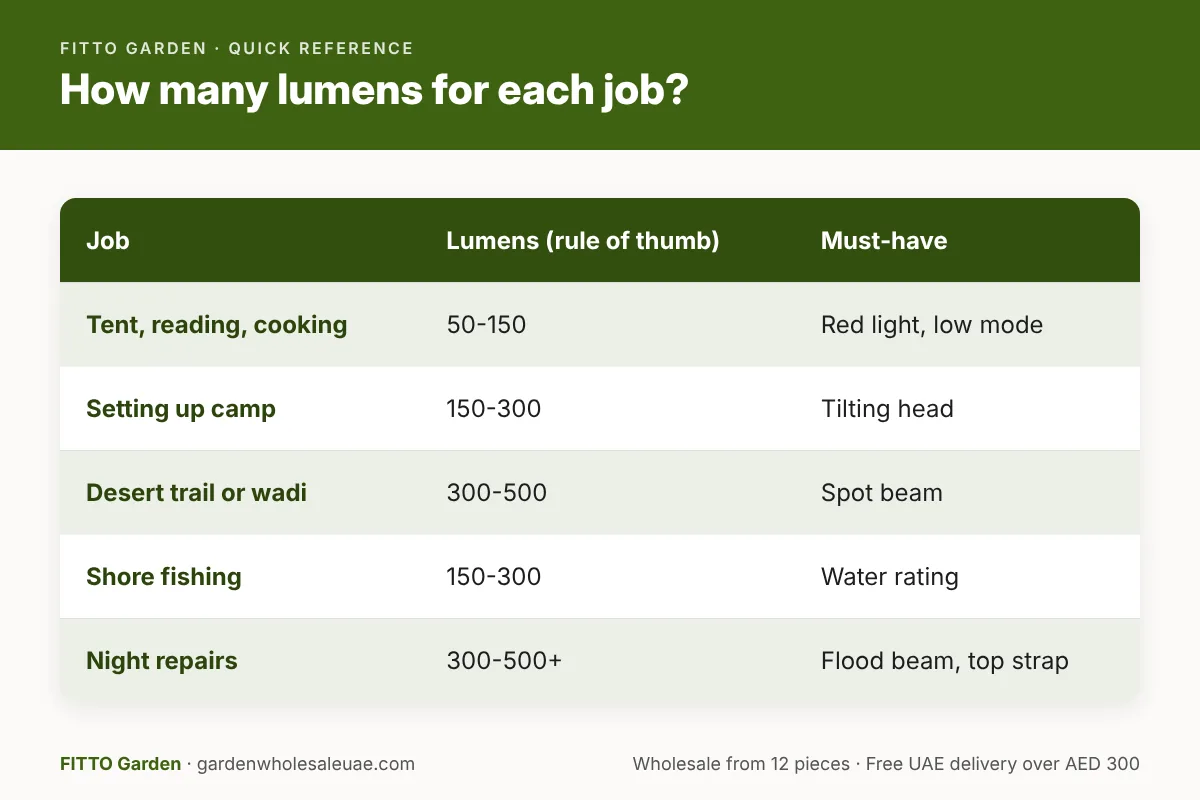
For most camp tasks, 100-300 lumens is plenty; trail walking, fishing and repairs benefit from 300 or more. Higher outputs are useful in short bursts, not all night.
| Job | Brightness guide (rule of thumb) | Features that matter |
|---|---|---|
| Reading, cooking, inside a tent | 50-150 lumens | Low mode, red light, wide beam |
| Setting up camp, walking around | 150-300 lumens | Tilting head, comfortable strap |
| Desert trail or wadi walk | 300-500 lumens | Spot beam, spare charge |
| Shore or pier fishing | 150-300 lumens plus red mode | Water rating, red light |
| Night maintenance and repairs | 300-500+ lumens | Flood beam, top strap, long runtime |
Lumens measure total light output. Many lamps are rated under the ANSI FL1 standard, which also gives beam distance and runtime in the same way, so those figures compare fairly between brands.
What do watts on a headlamp mean?
Watts describe the electrical power of the LED, not how much light reaches the trail. They help you compare models within one range, but not against a lumen figure from another brand.
FITTO headlamp listings give wattage: a 3 W rechargeable headlamp for close tasks, a 20 W multi-light headlamp and a 35 W high-brightness model. Within one range, a higher wattage generally means a brighter beam and a shorter runtime per charge.
The practical test is simple. Switch the lamp on in a dark room or car park and shine it on a wall 5 metres away. Check whether the beam is a tight spot, a wide flood or both, and whether the low mode is genuinely low.
How long should a headlamp battery last?
Expect long runtimes on low mode and short ones on high; check the box for runtime per mode, not one headline figure. Under ANSI FL1, runtime is measured until output falls to 10% of the starting level.
That means a lamp claiming many hours may be quite dim by the end. For a two-night desert trip, plan to use low or medium modes, fully charge before leaving and carry a power bank. Rechargeable lamps remove the cost and waste of disposable batteries, which matters for teams using lights every night.
Check the charging port too. USB-C is now common on phones and power banks, so one cable can charge everything; older micro-USB lamps need their own cable. Our camping lantern buying guide covers runtime and charging in more depth for area lights.
What makes a headlamp comfortable for a full night?
A wide, soft strap, a lamp that tilts down, and weight balanced front to back. Comfort decides whether a headlamp is worn or left in the bag.
- Strap: choose a wide elastic band that adjusts easily over a cap or ghutra. Humid coastal nights mean sweat, so a strap that can be removed and washed lasts longer.
- Tilt: a hinged lamp body points the beam at your hands without bending your neck.
- Weight: heavier, high-output lamps feel better with a top strap or a battery box at the back.
- Buttons: large buttons work with gloves, and a lock-out stops the lamp switching on in a bag.
Which water rating do you need?
IPX4 covers rain and splashes; choose IPX6 or higher for spray, and IPX7 if the lamp could be dropped in water.
| Rating | What it means | Good for |
|---|---|---|
| IPX4 | Splashes from any direction | Camping, dew, light rain |
| IPX6 | Powerful water jets | Boat decks, heavy spray |
| IPX7 | Immersion to 1 m for 30 minutes | Shore fishing, wading, kayaks |
| IPX8 | Immersion beyond 1 m, as the maker states | Specialist water use |
Dust matters in the desert as well. A first digit, as in IP54 or IP67, rates dust protection; an X means it was not tested for dust. Some lamps, like FITTO's waterproof LED headlamp, are described as waterproof without a number, so check the packaging for the exact rating.
How do you look after a rechargeable headlamp in UAE heat?
Keep it out of hot cars, charge it before storage and wipe sand from the seals. Heat is the main enemy of lithium batteries.
- Never leave headlamps on a dashboard or in the boot during summer.
- After a trip, brush sand from the buttons and charging cover, then close the cover fully.
- For long storage, leave the battery partly charged and keep it indoors in a cool cupboard.
- Charge fully the night before a trip and test every mode.
For a full camp kit list, see our camping gear guide for desert and beach trips.
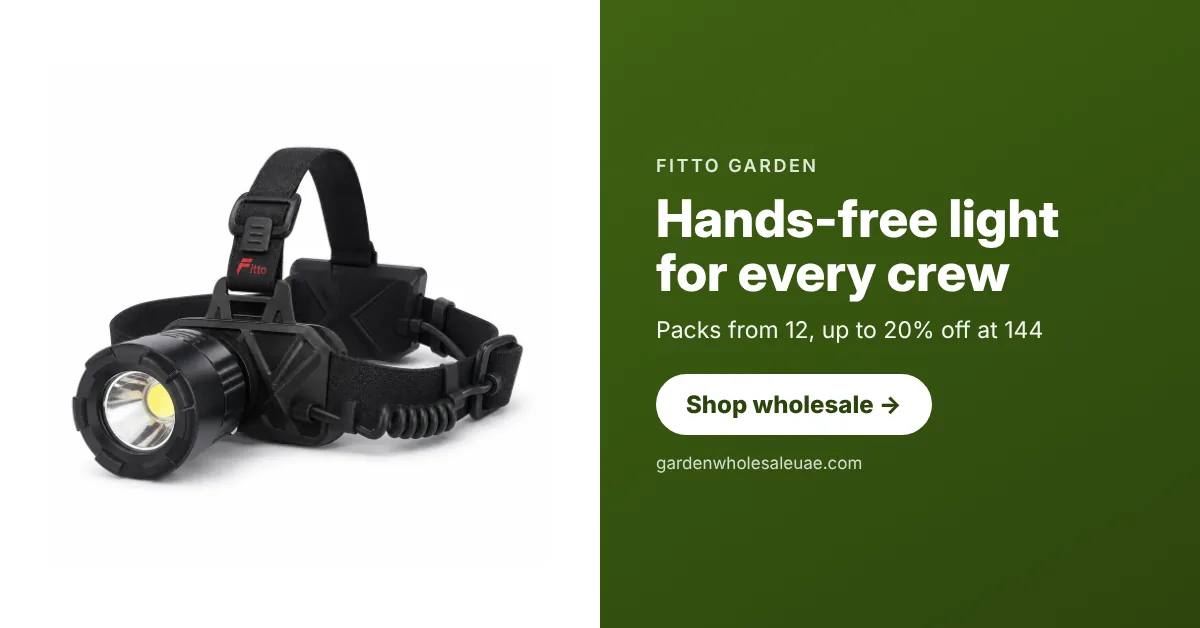
FITTO Trade Pick: Hands-free light for every crew Outfit campers, anglers and maintenance teams with the 35 W rechargeable LED headlamp for high-output work and the 3 W rechargeable headlamp for close tasks. Packs start at 12 pieces, with up to 20% off per piece at 144, so retailers can stock both.
The bottom line
Buy a rechargeable headlamp by job: 100-300 lumens for camp tasks, 300 or more for trails and repairs. Choose a comfortable tilting design, the right water rating and a common charging port, and keep it out of hot cars.
Browse our camping and outdoor gear range, request a quote for retail or team quantities, or order a sample to test the beam yourself. Delivery is free across all seven emirates over AED 300, and our team answers on WhatsApp at +971 55 672 6947. FITTO Garden: fit for the way you grow.
FAQ
Is a brighter headlamp always better?+
No. Very high output drains the battery quickly, heats the lamp and dazzles anyone you look at. For most camp tasks, 100-300 lumens is enough. Choose a lamp with a genuinely low mode for close work and a brighter mode you can use in short bursts.
Why do headlamps have a red light?+
Red light lets your eyes stay adjusted to the dark, so you can still see the stars and the campsite around you. It is also less likely to dazzle friends or other anglers. Use it for reading maps, moving around a tent at night and fishing from a shared pier.
Can I charge a headlamp from a power bank?+
Usually, yes. Most rechargeable headlamps charge by USB, so a power bank works on multi-night trips. Check whether your lamp uses USB-C or micro-USB and pack the right cable. Charge in shade, not on a hot car seat, and unplug once the indicator shows full.
Is a headlamp better than a torch for night work?+
For tasks that need both hands, yes. A headlamp keeps light where you look while you hold tools, rope or fittings. A handheld torch still throws further for searching or spotting at distance. Many maintenance teams carry both: a headlamp for the job and a torch for the walk.